Tecnifibre Wall Master 370
✓Cross-checked with official data from Tecnifibrehow we score
PADELTESTLAB SCORE
0-100 scale
83/100
Price range
Description
Who this racket is for
Pros
- ✓The Kern Eva Touch core in a soft-EVA build gives you long ball exit without forcing the arm, which pays off on deep lobs and rushed wall exits The D-Bridge centralises weight and widens the sweet spot: off-centre hits, near the throat or close to the frame, still fly with usable direction The low balance paired with the 360-375g weight lets you correct your wrist mid-swing on crossed volleys and quick net exchanges Spin Skin Rough keeps a strong bite on the ball for cut bandejas and lifted viboras, and the X-TOP treatment slows the abrasion typical of rough-textured faces The TEI carbon fibre absorbs impact instead of sending it back to the elbow, a real plus over long tactical matches
Cons
- ✗Power doesn't come for free: on flat smashes down the line you have to generate all the speed yourself, since the soft EVA cushions rather than catapults The low balance costs inertia on the smash and the finishing vibora; players looking to close points in one shot will feel it's lacking It's a previous-generation racket within the Wall Master range, with stock now limited in shops The 38mm profile and soft rubber demand a player with a grooved technique: without a long, clean swing, the ball dies mid-court
PADELTESTLAB SCORE
0-100 scale
83/100
It is at its lowest price since we started tracking it: €133.95, down from €149.95. We began recording on March 20.
Prices recorded daily since March 20 · 85 days of data
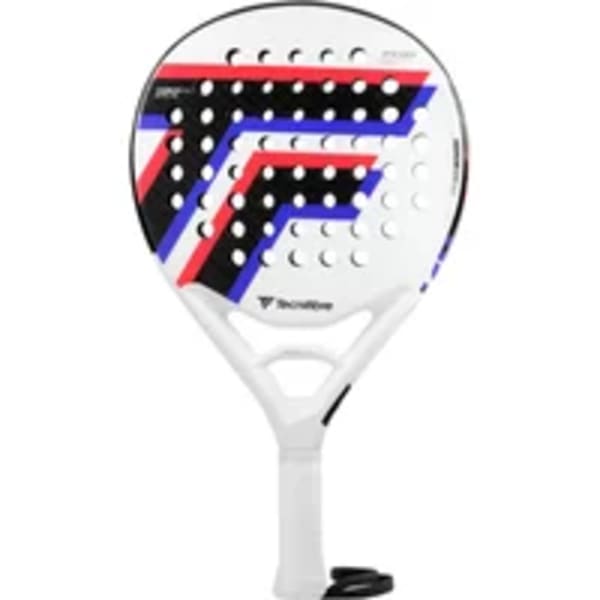
Tecnifibre Wall Master 370 review: the round racket built for the long rally
The Tecnifibre Wall Master 370 is a round-shaped padel racket weighing 360-375g, with a 38mm frame, low balance and a Kern Eva Touch soft-EVA core, plus a mixed carbon face combining TEI carbon fibre and X-TOP aramid. Everything about it points the same way: sustain the rally, don't end it.
This is a padel racket for advanced players who understand that points are won on the sixth ball, not the first.
Who should actually play with the Wall Master 370?
It suits the advanced, strategic player who defends a lot and attacks only when the ball arrives on a silver platter. The round shape, low balance and soft rubber combine to prioritise precision and stability over raw pop, backed by a huge sweet spot that forgives off-centre contact. This isn't a racket for finishers.
If your game revolves around closing points with a flat smash down the line and an aggressive vibora, this Tecnifibre will frustrate you. If your game is about not missing and waiting for your opponent's error, it goes straight on your shortlist.
Tecnifibre Wall Master 370 specs
| Spec | Value |
|---|---|
| Shape | Round |
| Weight | 360-375 g |
| Balance | Low |
| Frame | 38 mm |
| Face | Mixed — TEI Carbon Fiber + X-TOP aramid |
| Core | EVA Soft (Kern Eva Touch) |
| Surface | Rough, 3D Grain effect |
| Level | Advanced |
| Playstyle | Control |
| Technologies | Spin Skin Rough, PHD, X-TOP, D-Bridge, Carbon Shield XTC |
TEI Carbon + X-TOP: two fibres, two different jobs
The face isn't uniform, and that's exactly where the feel comes from. The TEI carbon fibre handles impact absorption: instead of sending vibration back into the forearm, it dissipates it, which eases joint strain over two-hour matches.
X-TOP is a PTFE-treated aramid, and its job is different: protecting the surface from abrasion. It answers the classic complaint with rough-faced rackets, which bite hard the first month and smooth out after. Here, the 3D Grain texture with Spin Skin Rough holds its bite through far more sessions.
Carbon Shield XTC reinforces the structure without stiffening the feel, and PHD helps transmit the shot through to the grip.
D-Bridge: why the sweet spot is so forgiving
The D-Bridge bridge centralises weight around the racket's axis. That has two practical effects.
First, tolerance: balls that catch the lower third of the face or clip the frame still come off with usable direction. On a mistimed wall exit, the Wall Master 370 won't leave you with a dead ball stranded mid-court.
Second, maneuverability. With weight concentrated centrally and a low balance, the racket turns fast in your hand. You feel it on reaction volleys, when your opponent fires a contra at your feet and you need to open the face in a split second.
Shot by shot: how it plays
Defense and wall exits. This is its home turf. The soft EVA gathers and releases the ball with long ball exit, so deep lobs come off without needing to rush the arm. You can defend comfortably from the back for long exchanges.
Bandeja. Excellent. The rough, 3D-textured surface bites into the ball on the cut, and the low balance lets you fine-tune the height of contact without the head dropping.
Vibora. Works in placement mode, hunting the side bounce and the corner, not as a winner shot. It lacks the top-end mass to make the ball heavy on the bounce.
Smash. The weak point. On a flat or kick smash you have to supply all the pace yourself: the soft core cushions the impact rather than catapulting it. With good technique you'll still get depth; with average technique, the ball falls short.
Volleys. Solid and precise. The block is clean and control against the opponent's back-wall exchanges is strong thanks to the cushioned feel.
4 reasons to buy it — and 2 reasons to skip it
- You defend more than you attack and want a racket that won't punish your elbow.
- You miss shots from off-centre contact and need real tolerance.
- Your bandeja is your main transition shot and you want lasting bite.
- You play long matches where the player who misses less wins.
Skip it if you're after instant pop from the first shot, or if your level doesn't yet let you generate your own racket head speed: the 38mm profile with soft rubber demands a long, clean swing.
Verdict: control with a use-by date
The Wall Master 370 delivers exactly what it promises — precision, stability and defensive answers — within Tecnifibre's Wall Master range. The catch is that it's already a previous-generation model with limited availability, so tracking one down means hunting for leftover stock.
As part of a pair, it works best as the racket for the player who builds the point from the backhand, alongside a partner with more firepower to close out at the net. Two Wall Master 370s on the same court makes for a very long match.
Anyone moving on from a stiff racket looking to ease elbow strain without losing control will notice a real change in feel here. Anyone chasing power won't.
In the brand's lineup
Within tecnifibre's lineup, the wall master 370 occupies the mid-range starting at €139.95, offering highly competitive value for its segment. Its overall score of 83/100 places it among the best control rackets we've reviewed.
Frequently asked questions
Who is the Tecnifibre Wall Master 370 for?
The Tecnifibre Wall Master 370 targets advanced players. It needs consolidated technique and is not recommended for beginners.
How much does the Tecnifibre Wall Master 370 weigh?
The Tecnifibre Wall Master 370 weighs 360-375g according to the manufacturer's stated specs.
What's the Tecnifibre Wall Master 370's PadelTestLab score?
The Tecnifibre Wall Master 370 scores 83/100 in our review, based on power, hardness, control, maneuverability, ball exit, sweet spot and surface roughness.
How much does the Tecnifibre Wall Master 370 cost?
Current price of the Tecnifibre Wall Master 370 is 139.95€ – 195.84€, comparing 3 shops in our finder.
Similar alternatives
Other rackets with a similar profile and price range: