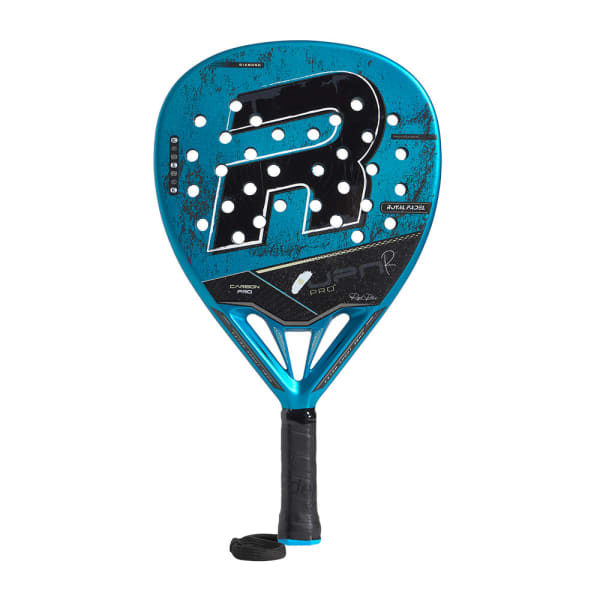
Royal Padel Japan Pro Blue
✓Cross-checked with official data from Royal Padelhow we score
PADELTESTLAB SCORE
0-100 scale
78/100
Price range
Description
Who this racket is for
Pros
- ✓The polyethylene core cushions the impact without killing the ball exit: on a smash by 3 the ball rockets off the face even when contact isn't dead centre The rough 3D Hex Weave texture really bites into the ball, translating into viboras with genuine kick and cut bandejas that stick tight to the glass The head-heavy diamond balance loads mass into the head and delivers brutal hitting weight on the flat smash, well above what an equivalent round-shaped racket offers The Shock Absorption system filters out a good chunk of impact vibration, making this power racket easier on the elbow and shoulder than most in its category The 360-380g weight range lets you pick your version: lower for extra racket-head speed, higher to maximise inertia on the smash
Cons
- ✗The head-heavy balance punishes you on defence: if you're late reacting to a low ball off the back wall, the head is too heavy for the racket to come round in time for the lob
PADELTESTLAB SCORE
0-100 scale
78/100
It is at its lowest price since we started tracking it: €184.95, down from €320.00. We began recording on March 20.
Prices recorded daily since March 20 · 81 days of data
Royal Padel Japan Pro Blue Review: A 38mm Diamond Racket Built to Finish Points
The Royal Padel Japan Pro Blue is a diamond-shaped, head-heavy padel racket with a 38mm profile, Fibretech fibreglass face, polyethylene core and a weight range of 360-380g. Everything about it points to one place: the front of the court.
This isn't a compromise racket. It's an attacking tool for advanced players who already have their smash and overhead game sorted and want the racket to add firepower, not paper over technical gaps.
What does Fibretech bring compared to a carbon face on the Japan Pro Blue?
Fibretech fibreglass is more elastic than a carbon weave. On contact, the face flexes for a fraction longer before releasing the ball, and that micro-delay is what creates the trampoline effect.
In practice, that means the ball flies off the face fast with minimal arm effort. It's what makes this Royal Padel model forgiving on off-centre or awkward-body-position hits, which is unusual for a diamond shape.
The trade-off is that fibreglass has less precision than carbon. In tight blocking volleys, where you want the ball to die close to the net, the face tends to send back more depth than you asked for.
The polyethylene core: why this power racket doesn't wreck your elbow
The high-density polyethylene core is the other key player here. Compared to an equivalent hard EVA core, polyethylene compresses more on contact and springs back into shape instantly.
That behaviour produces what you could call controlled aggression: the shot hits hard, but the impact reaches your arm already filtered. The Shock Absorption system pulls in the same direction, cutting the vibration that travels up to the elbow and shoulder.
For a player smashing repeatedly through a match, that detail matters more than a couple of extra km/h.
| Spec | Value |
|---|---|
| Shape | Diamond |
| Balance | Head-heavy |
| Weight | 360-380g |
| Face | Fibreglass (Fibretech) |
| Core | Polyethylene |
| Frame | 38mm |
| Surface | Rough, 3D texture |
| Technologies | 3D Hex Weave, Shock Absorption |
| Level | Advanced |
| Playstyle | Power |
Shot by shot: how it plays
Flat smash and smash by 3. This is where the racket earns its keep. The diamond shape with head-heavy balance loads mass up top and multiplies inertia; on the 380g version the hitting weight is seriously punishing. The high ball exit means you don't need a maxed-out swing for the ball to fly.
Vibora and bandeja. The 3D Hex Weave texture is the other big selling point. That rough surface grips the ball and generates real, not decorative, spin. The vibora comes off with enough kick to lift the opponent off the ground, and a cut bandeja sticks tight to the glass when you follow through properly.
Volleys. It performs well on aggressive volleys aimed deep. On containment volleys, with little reaction time, it's harder to control touch — the combination of high ball exit and an elastic face sends back more pace than you bargained for.
Defence and wall exits. The weak point. Maneuverability is limited by the head-heavy balance, forcing earlier preparation. If the ball comes off the back wall fast and you're a touch late, the head weight means the racket can't turn in time to get the lob up. It's not a flaw so much as the cost of the shape.
Who is the Royal Padel Japan Pro Blue for?
For advanced players with solid technique and a trained shoulder who spend most of the point above the net. You'll need fast hands to control the 360-380g weight and the judgement to not overhit, because the racket offers little forgiveness up top.
It's particularly well suited to the backhand side of a pair where the other player handles the point construction. If you're the one holding down long rallies from the back and digging tricky balls off the wall, this racket will make you work overtime.
Players in the lower half of the intermediate level should look at round-shaped rackets instead: the sweet spot here is narrow, and off-centre hits show up immediately.
Blue vs Red: what actually changes
The 2026 Blue and Red versions share identical specs. Same shape, same profile, same materials, same technologies. The only difference is the colourway.
The choice comes down to looks, not performance. Anyone after a different feel needs a different model, not a different colour.
Verdict
The Japan Pro Blue does one thing and does it very well: turns court position into winning smashes. The Fibretech-and-polyethylene combo gives it power with a very generous ball exit, and the 3D Hex Weave texture adds the spin that separates a vibora that annoys from one that wins the point outright.
In return, it demands early preparation on defence, punishes off-centre contact, and isn't the racket for anyone who wants fine touch at the net. If your game lives up top and your elbow appreciates a racket that filters vibration, this is a genuinely coherent buy. If you're torn between attacking and building points, this isn't your racket.
In the brand's lineup
Within royal padel's lineup, the japan pro blue occupies the mid-range starting at €189.95, offering highly competitive value for its segment. With an overall score of 78/100, it's a solid choice within its price range.
Frequently asked questions
Who is the Royal Padel Japan Pro Blue for?
The Royal Padel Japan Pro Blue targets advanced players. It needs consolidated technique and is not recommended for beginners.
How much does the Royal Padel Japan Pro Blue weigh?
The Royal Padel Japan Pro Blue weighs 360-380g according to the manufacturer's stated specs.
What's the Royal Padel Japan Pro Blue's PadelTestLab score?
The Royal Padel Japan Pro Blue scores 78/100 in our review, based on power, hardness, control, maneuverability, ball exit, sweet spot and surface roughness.
How much does the Royal Padel Japan Pro Blue cost?
Current price of the Royal Padel Japan Pro Blue is 189.95€ – 255.95€, comparing 3 shops in our finder.
Similar alternatives
Other rackets with a similar profile and price range: