Kombat Etna 2025
✓Cross-checked with official data from Kombathow we score
PADELTESTLAB SCORE
0-100 scale
79/100
Price range
Description
Who this racket is for
Pros
- ✓That rough-textured 12K carbon face bites into the ball on viboras and cut smashes — real kick, real bounce off the deck. Head-heavy weight distribution and that diamond shape stack mass right where it counts, giving you extra ball speed on the smash by 3 and on flat smashes that a round-shaped racket simply can't match. The Sharp Hole System redistributes weight and stretches the effective hitting zone toward the upper part of the face, so slightly off-centre smashes don't bleed all their pace. That medium-density Black EVA core dodges the rock-hard feel so many diamonds suffer from — there's genuine cushioning on firm blocked volleys and off-the-back-wall exits when you commit to the shot. And the fully tubular 100% carbon fibre frame keeps torsion in check on fast body shots and blocking volleys against a hard smash, so the face doesn't twist on you
Cons
- ✗At 360-370 grams with a head-heavy balance, your wrist pays for it by the third set — arrive late to a bandeja and the racket suddenly feels too long, forcing you to push the ball instead of hitting through it. Ball exit gives you nothing for free: defensive lobs from the back need a full arm swing, because blocking with the face alone falls short. Away from the upper-centre sweet spot it's still very much a diamond — low volleys, dropshots and sliced balls come back feeling flat, and dialling in depth takes real touch. And that aggressive rough texture, while great for spin, chews through balls and the face finish fast, especially outdoors on sandy courts
PADELTESTLAB SCORE
0-100 scale
79/100
It is at its lowest price since we started tracking it: €99.95, down from €129.00. We began recording on March 21.
Prices recorded daily since March 21 · 72 days of data
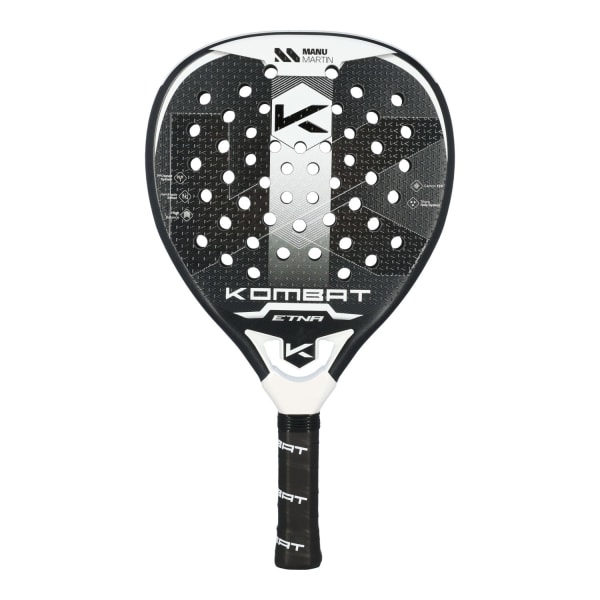
The Kombat Etna 2025 doesn't hide what it's built for: diamond shape, head-heavy balance, a 12K carbon face and a weight of 360-370 grams. It's the signature racket of pro coach Manu Martín, engineered for players who finish points at the net.
This isn't an all-court racket dressed up as an attacking one. It's a genuine power racket, with everything that entails.
Kombat Etna 2025 specs: full breakdown
| Spec | Detail |
|---|---|
| Shape | Diamond |
| Weight | 360-370 g |
| Balance | High |
| Face | 12K Carbon |
| Core | Medium-density EVA (Black EVA) |
| Surface | Rough |
| Level | Advanced |
| Playstyle | Power |
| Technologies | Sharp Hole System, 100% carbon fibre tubular frame |
| Player | Manu Martín |
What level of player is the Kombat Etna 2025 for?
This is a racket for advanced players with solid technique and a trained arm. That combination of diamond shape, head-heavy balance and 360-370 grams demands early preparation and your own racket-head speed — it won't bail you out of bad timing. If your game is built around closing out points at net, it's a great fit. If you spend most of your time grinding from the back, it'll wear you down.
12K carbon and Black EVA: where that feel comes from
The 12K carbon weave gives a stiff face that returns energy fast, with minimal give. That's what makes flat smashes come off clean, without that half-second of the ball sitting on the strings too long.
The medium-density Black EVA core is the smart call here. Pair this shape and balance with a harder rubber and you'd have something unplayable for almost anyone outside competitive level.
At medium density, the core adds just enough cushioning on blocked volleys and on longer contact off a wall exit. The feel stays firm and crisp, but it still tells you where the ball landed on the face.
The rough surface is the other key ingredient. On a cross-court vibora and on cut smashes, that texture grips the ball just enough that the spin translates into a high, kicking bounce — not just raw pace.
Sharp Hole System and tubular frame: what they actually change on court
The Sharp Hole System reworks weight distribution and the usable hitting area, pushing the sweet spot toward the upper part of the face. On a diamond shape, that detail matters more than on any other — the natural smash contact point sits high, and that's exactly where a couple of centimetres off-centre usually costs you.
In practice, that means a smash struck two fingers above centre still carries real pace, instead of dying halfway down the court.
The fully tubular 100% carbon fibre frame supplies the other half: torsional stiffness. On fast body shots and blocking volleys against a heavy smash, the face doesn't twist open, and the ball goes where you aimed it.
Smash, vibora, bandeja: how it plays shot by shot
- **Smash by 3 and flat smash.** This is where it lives. The head-heavy weight generates ball speed with surprisingly little visible effort, as long as you complete the swing.
- **Vibora.** The rough 12K face turns cut into genuine spin. The ball skids low off the strings and kicks wide toward the back glass.
- **Bandeja.** This is where it demands more. The head-heavy balance forces earlier preparation than usual — get your elbow there late and the bandeja comes out short and central.
- **Wall exit.** Works when you attack the ball. Wait for the racket to do the work for you, and it won't.
- **Volley.** Firm and penetrating through the centre of the face, but uncomfortable on low volleys and delicate dropshots.
Where it'll punish you
Maneuverability is the obvious trade-off. With this weight distribution, fast net exchanges and reflex volleys off body shots demand a strong wrist and sharp footwork.
The second trade-off is ball exit. This isn't a racket that helps you lift deep defensive lobs from an awkward position — it demands a full arm swing and total commitment to the shot.
And the third is margin for error. The sweet spot is more forgiving than your typical diamond, but make no mistake, it's still a diamond.
Who should — and shouldn't — play with the Etna
It suits an attacking backhand-side player, or a forehand player who's confident smashing by 3 regularly. Advanced level, clean smash technique, solid upper-body strength.
As a doubles partner, it works well alongside someone with a more controlled, easy-exit racket who can sustain the rally while the Etna's owner hunts for the winner.
It's not the right fit if your matches are decided from the back of the court, if you're carrying elbow or shoulder niggles, or if your bandeja technique is still a work in progress.
Verdict: a finisher's racket, no excuses
The Kombat Etna 2025 does exactly what its spec sheet promises: it hits hard. The clever part is the internal balance between a stiff 12K face and a medium-density rubber that stops the whole package from being excessively brutal.
In return, it demands a player who's always on time to the ball. With a trained arm and a reliable smash, it's a serious finishing tool; without that profile, a lower-balance racket will win you more matches.
In the brand's lineup
Within Kombat's lineup, the Etna 2025 occupies the mid-range starting at €109.95, offering highly competitive value for its segment. With an overall score of 79/100, it's a solid choice within its price range.
Frequently asked questions
Who is the Kombat Etna 2025 for?
The Kombat Etna 2025 targets advanced players. It needs consolidated technique and is not recommended for beginners.
How much does the Kombat Etna 2025 weigh?
The Kombat Etna 2025 weighs 360-370g according to the manufacturer's stated specs.
What's the Kombat Etna 2025's PadelTestLab score?
The Kombat Etna 2025 scores 79/100 in our review, based on power, hardness, control, maneuverability, ball exit, sweet spot and surface roughness.
How much does the Kombat Etna 2025 cost?
Current price of the Kombat Etna 2025 is 109.95€, comparing 1 shop in our finder.
Similar alternatives
Other rackets with a similar profile and price range: