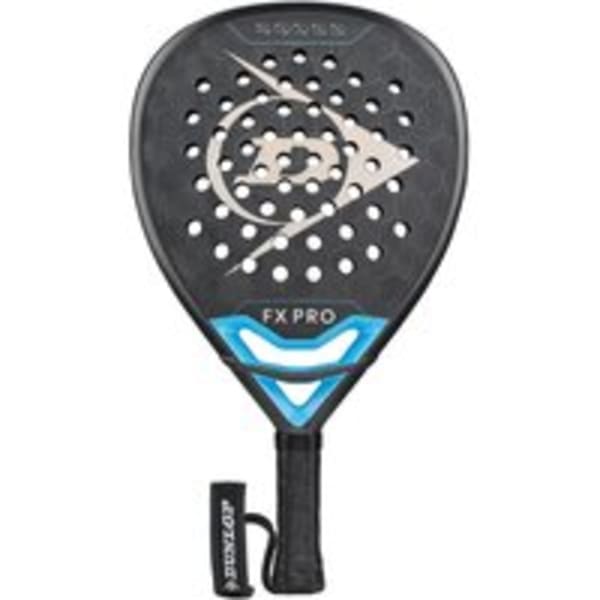
Dunlop Fx Pro
✓Cross-checked with official data from Dunlophow we score
PADELTESTLAB SCORE
0-100 scale
78/100
Price range
Description
Who this racket is for
Pros
- ✓12K Special Weave Carbon over a 38mm profile gives you a crisp, compact response on the smash for 3: the ball comes off flat with minimal contact time — exactly what a power hitter wants Force Bridge and Power Holes work the upper part of the face, right where the balance stacks the mass, so the smash only rewards you when you attack the ball above shoulder height SpinBoost combined with the sandy surface bites into the ball on the crosscourt vibora and the cut bandeja: you get kick without having to force the wrist Sonic Core Infinergy and VibroShield soak up a good chunk of impact vibration, which is rare in a hard 375g diamond and lets you play longer sessions without punishing your elbow and wrist The medium-hardness Pro EVA avoids the plank-like feel of other power diamonds: there's a touch of dwell time before the ball leaves the face, especially useful on finishing volleys
Cons
- ✗The high balance forces you to prep your arm early on defence; scrambling off the back wall or on a low return, the head-heavy weight leaves you arriving with an open racket face The sweet spot sits high and runs narrow: catch the ball near the throat or off to the side of the face and it dies on you, with the off-centre hit obvious immediately At 365-375g in a diamond shape, quick hands at the net take a hit: in a fast volley-to-volley exchange it's hard to reset the racket face between shots This isn't a racket that gives you free points on the block; a deep defensive lob has to be built with legwork and follow-through — the material won't do it for you
PADELTESTLAB SCORE
0-100 scale
78/100
It is at its lowest price since we started tracking it: €151.95, down from €199.25. We began recording on April 10.
Prices recorded daily since April 10 · 60 days of data
Dunlop FX Pro Review: The 38mm Diamond Racket That Demands Arm Work for Its Power
The Dunlop FX Pro is a diamond-shaped, head-heavy padel racket with a 12K Special Weave Carbon face, a medium-hardness Pro EVA core and a 38mm profile, weighing in at 365-375g. It sits within Dunlop's FX Series, launched in 2026 as the brand's performance-and-power line.
This is a racket with a clear identity: mass up top, a rigid face, and a tech stack — Force Bridge, SpinBoost, Power Holes, Sonic Core Infinergy and VibroShield — all built around one idea: making the smash hit hard without your arm footing the entire bill.
Dunlop FX Pro Specs at a Glance
| Spec | Value |
|---|---|
| Shape | Diamond |
| Balance | High (head-heavy) |
| Weight | 365-375g |
| Face | 12K Special Weave Carbon |
| Core | Pro EVA (medium hardness) |
| Frame | 38mm |
| Technologies | Force Bridge, SpinBoost, Power Holes, Sonic Core Infinergy, VibroShield |
| Recommended level | Advanced |
| Playstyle | Power |
| Surface texture | Sandy finish |
Who Is the Dunlop FX Pro Built For?
Advanced players with solid technique. The combination of diamond shape, head-heavy balance and 365-375g demands early preparation and an already-grooved smash mechanic. An intermediate player might crush three smashes in a row, but the fourth one costs them: mishits off-centre, a late arm on defence, and a lob that falls short.
The honest read is that this Dunlop racket rewards players who already strike the ball well and punishes those still building their swing.
What Each Technology Does When the Ball Is in Play
The 12K Special Weave Carbon is a dense-weave carbon fabric: it shortens contact time and delivers a crisp, dry sensation. On the flat smash that means the ball leaves the face sooner with less deformation, resulting in a tighter, more penetrating trajectory.
Force Bridge reinforces the throat area, the zone where a diamond shape concentrates stress on a smash. Power Holes sits in the upper part of the face — exactly where the head-heavy balance places the mass — which is where the racket really generates its push.
SpinBoost and the sandy surface form the spin package. It shows up more on the crosscourt vibora and the cut bandeja than on a topspin groundstroke: the racket bites into the ball without needing an exaggerated wrist snap.
The comfort package comes from Sonic Core Infinergy and VibroShield, which absorb part of the impact shock. They don't turn the FX Pro into a soft racket — it's still a hard diamond — but they filter out the vibration that usually comes with this kind of build.
How the FX Pro Plays, Shot by Shot
Smash for 3 and flat smash. This is where the racket makes the most sense. The top-heavy mass and rigid face produce a fast, flat ball exit. Attack it above shoulder height with your body behind the shot, and the FX Pro delivers real pop.
Bandeja and vibora. The bandeja comes out comfortably thanks to the spin the sandy surface generates, though the head-heavy weight means you need to drive the shot from the shoulder, not just the forearm. The vibora is arguably the racket's best shot in terms of effort-to-reward ratio.
Volley. On finishing volleys it responds well: there's a bit of dwell time in the Pro EVA before the ball releases, giving you room to place it. In fast volley-to-volley exchanges, though, maneuverability is limited and resetting the face between shots takes effort.
Defence and off-the-back-wall retrieves. The weak point. The head-heavy balance punishes you when you're rushed: the head drags, the face tends to open up, and a deep defensive lob has to be built with legwork. This isn't a racket that bails you out on the block.
Sweet spot. Narrow and shifted upward, in keeping with the shape's geometry. Catch it near the throat and you'll feel the ball die immediately.
Five Things That Define This Racket
- Power as the core design principle, not an afterthought.
- Conditional ball exit: the racket doesn't do the work alone — it needs arm input.
- Accessible spin on cut shots thanks to SpinBoost and the sandy surface.
- Above-average comfort for its category, courtesy of Sonic Core Infinergy and VibroShield.
- Maneuverability as the trade-off for 365-375g with mass loaded up top.
Which Player Profile and Pairing Suits the FX Pro Best?
A forehand or backhand player who attacks from the net and wants to close out points on the first smash rather than grind it out with repeated bandejas. If your game plan is to defend, extend rallies and wait for the opponent's error, this isn't your racket.
As a doubles pairing, it works well alongside a partner running a control racket with a lower balance who can sustain the rally and set up the lob. Two power diamonds on the same court tends to end in unforced errors from the back of the court.
Verdict: Power With Less of the Usual Punishment
The Dunlop FX Pro delivers on its spec sheet: explosive power from a head-heavy diamond shape, tempered by a shock-absorption package that softens the impact. The medium-hardness Pro EVA is the smartest call in the whole build, since it avoids the plank-like feel typical of this kind of power racket.
The drawbacks are structural, not flaws: modest maneuverability, a narrow sweet spot, and a defensive game that demands strong legwork. If you're an advanced player who attacks above the shoulder and wants a power racket that won't wreck your elbow halfway through the season, the FX Pro makes a strong case. If you need the racket to bail you out on the block and off the back wall, look elsewhere.
In the brand's lineup
Within dunlop's lineup, the fx pro occupies the mid-range starting at €168.95, offering highly competitive value for its segment. With an overall score of 78/100, it's a solid choice within its price range.
Frequently asked questions
Who is the Dunlop Fx Pro for?
The Dunlop Fx Pro targets advanced players. It needs consolidated technique and is not recommended for beginners.
How much does the Dunlop Fx Pro weigh?
The Dunlop Fx Pro weighs 365-375g according to the manufacturer's stated specs.
What's the Dunlop Fx Pro's PadelTestLab score?
The Dunlop Fx Pro scores 78/100 in our review, based on power, hardness, control, maneuverability, ball exit, sweet spot and surface roughness.
How much does the Dunlop Fx Pro cost?
Current price of the Dunlop Fx Pro is 168.95€ – 187.24€, comparing 4 shops in our finder.
Similar alternatives
Other rackets with a similar profile and price range: