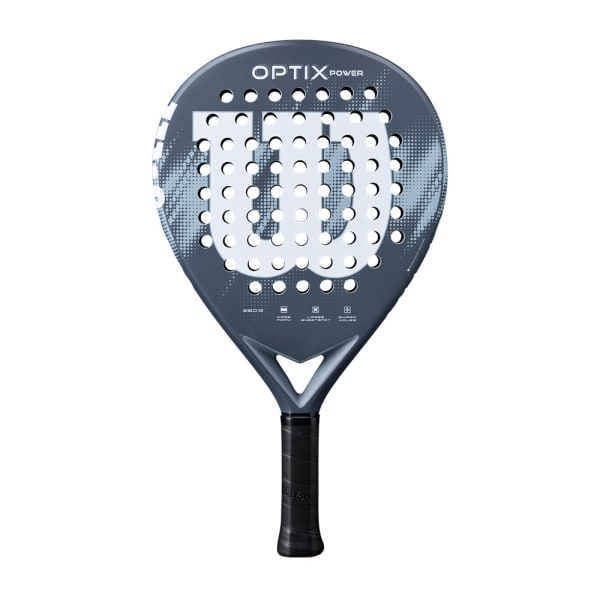
Wilson Optix V2 Power Blue
✓Cross-checked with official data from Wilsonhow we score
PADELTESTLAB SCORE
0-100 scale
79/100
Price range
Description
Who this racket is for
Pros
- ✓The Power Core's low-density foam produces sky-high ball exit — even a defensive block with barely any swing clears the wall and lands deep on the other side, the balance keeps mass up in the hitting zone and adds real weight to flat smashes and remates por 3 without demanding a polished wrist snap, the sweet spot is unusually generous for a teardrop shape, so off-centre backhand volleys still carry depth instead of dying in the net, the rough surface and Sharp Hole Technology profiling bite nicely into a new ball on vibora and cut bandeja, and at 360-365 g with that soft feel, your arm stays fresher deep into long matches since you never need to muscle the racket for rhythm
Cons
- ✗With power outweighing control, comfortable mid-height balls through the middle tend to sail long unless you close the face and add spin, the soft foam loses definition on chiquitas and dejadas — the ball sinks into the face and it's hard to kill it tight against the glass, the head-heavy teardrop balance demands early preparation, so rushed wall exits leave the head arriving late, and the fiberglass face won't give advanced ball-strikers the crisp, firm feedback they're after — the impact feels cushioned rather than solid
PADELTESTLAB SCORE
0-100 scale
79/100
Since March 20 it has ranged between €87.48 and €129.95. Today it sits at €119.95.
Prices recorded daily since March 20 · 55 days of data
The Wilson Optix V2 Power Blue hands you power you didn't even ask for: a head-heavy teardrop shape, fiberglass face, low-density foam core and 360-365 g of weight. Every part of the build points the same direction — get the ball off the strings fast, even when your arm isn't doing much work.
This isn't a scalpel, and it never claims to be. It's a power-oriented teardrop with a surprisingly soft feel, and that combination has very specific consequences on court.
Fiberglass Weave meets Power Core: where the pop comes from
The Fiberglass Weave face flexes noticeably more than a stiff, rigid surface. On contact it dishes in, loads up and springs back — the sensation is of the ball dwelling on the strings for a beat before rocketing out, rather than the instant, crisp response you get from a stiffer face.
Underneath sits the Power Core, built around a low-density foam. That core is directly responsible for the cushioned feel and the ball exit, which is the standout trait of the whole racket: block a high ball with half a swing and it still comes out with depth.
There's a useful side effect for tough matches. Since you're not forced to accelerate the racket to generate pace, your arm takes less punishment by the third set.
The 360-365 g weight plays into that balance. It's a contained number for a teardrop, so the racket never feels leaden sitting in your hand — the demand isn't about total weight, it's about where that weight sits.
What level of player is the Wilson Optix V2 Power Blue built for?
This one is aimed at intermediate players — and at crossovers from other racket sports — who don't yet generate much racket-head speed on their own. The Optix V2 Power Blue supplies that speed through the materials: a soft core, a wide sweet spot and very high ball exit. Anyone already hitting hard will find the control ceiling low.
Sharp Hole Technology and a rough face: the spin plan
The surface comes rough out of the box, and Sharp Hole Technology shapes the holes so the edges grip the ball. With a fresh ball it shows up on two specific shots: the vibora, which bites and dips sooner than the racket's modest weight would suggest, and the cut bandeja, where the side spin makes up for this padel racket not being especially firm off the face.
The chiquita, on the other hand, asks more of the racket than the foam can give. The ball sinks into the face and it's tough to leave it dead against the glass.
Shot by shot: where it gives you metres, and where it costs you
Three spots where this Wilson clearly pays off:
- **Flat smash and remate por 3.** The head-heavy balance stacks mass up top and does part of the job a clean wrist snap would normally handle. It's not a crisp smash, but it lands with weight behind it.
- **Defensive counter from the back.** With this core's ball exit, a no-swing block clears the wall and lands deep in your opponents' court.
- **Deep, off-centre volley.** The wide sweet spot forgives off-centre contact, and the ball holds its length instead of coming up short.
And two where it costs you:
- **Rushed exit off the back wall.** Teardrop shape plus head-heavy balance means early prep is non-negotiable; if the ball crowds you, the head arrives late and the shot loses direction.
- **Comfortable mid-height ball.** With power outmuscling control, that short lob tends to sail long unless you close the face and go looking for kick.
Wilson Optix V2 Power Blue: full spec sheet
| Spec | Value |
|---|---|
| Shape | Teardrop |
| Weight | 360-365 g |
| Balance | Head-heavy |
| Face | Fiberglass |
| Core | Low-density foam |
| Surface | Rough |
| Technologies | Power Core, Sharp Hole Technology, Fiberglass Weave |
| Level | Intermediate |
| Playstyle | Power |
Who should — and shouldn't — buy this Wilson
It suits the intermediate player looking to add pace and depth without overhauling their technique, and anyone who plays long sessions back-to-back and needs a racket that won't chew up their arm. As a doubles pairing, it works best alongside a controlling partner who dictates the point while this racket looks for the winner from the net.
I wouldn't recommend it if your issue is precision rather than power. Advanced players who already generate their own racket-head speed will miss a firmer response, a more defined touch on dejadas and chiquitas, and a bit more maneuverability down in defence.
Honest summary: the Wilson Optix V2 Power Blue is a soft, assisted-power racket that's remarkably easy to get pace from, with a low ceiling for fine control. If that's exactly what you're shopping for, it delivers without any surprises.
In the brand's lineup
Within wilson's lineup, the optix v2 power occupies the mid-range starting at €104.9, offering highly competitive value for its segment. With an overall score of 79/100, it's a solid choice within its price range.
Frequently asked questions
Who is the Wilson Optix V2 Power Blue for?
The Wilson Optix V2 Power Blue fits the intermediate level. Suited to players with a technical base who want to progress without jumping to a competition racket.
How much does the Wilson Optix V2 Power Blue weigh?
The Wilson Optix V2 Power Blue weighs 360-365g according to the manufacturer's stated specs.
What's the Wilson Optix V2 Power Blue's PadelTestLab score?
The Wilson Optix V2 Power Blue scores 79/100 in our review, based on power, hardness, control, maneuverability, ball exit, sweet spot and surface roughness.
How much does the Wilson Optix V2 Power Blue cost?
Current price of the Wilson Optix V2 Power Blue is 104.9€ – 129.95€, comparing 5 shops in our finder.
Similar alternatives
Other rackets with a similar profile and price range: