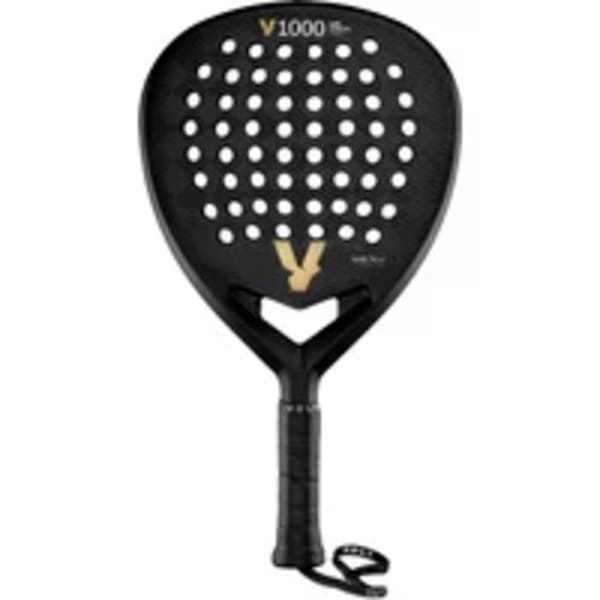
Volt Padel 1000 V23
✓Cross-checked with official data from Volt Padelhow we score
PADELTESTLAB SCORE
0-100 scale
78/100
Description
Who this racket is for
Pros
- ✓The rough-textured 12K carbon bites into the ball on víboras and cut bandejas: sidespin comes off with less wrist effort and the ball kicks wider off the bounce The diamond shape paired with a head-heavy balance stacks mass up top, which shows up as a flat, heavy smash off the third bounce without needing to overswing The medium-density Black EVA soaks up impact on full-speed shots without bottoming out, yet still gives some ball exit on blocked volleys The Dynamic Holes System spreads the face's holes for aerodynamics: you feel it in arm speed when you have to jump up for back-to-back smashes The 3K Carbon Frame with its 38mm profile keeps the frame solid on off-centre hits toward the tip, exactly where a racket with this balance usually struggles
Cons
- ✗The head-heavy balance means you need to set up early on defence: on a rushed wall exit or a lob that catches you out, the head drags and you arrive with the face out of position The sweet spot is small and sits high on the face; contact near the throat feels dead and lacks depth At 350-370g with a medium-hard rubber, two hours of match play take a toll on the elbow and shoulder if your technique isn't dialled in This isn't a racket for building points from the back: defensive blocks and rising lobs demand more arm work than a neutral-balance racket
PADELTESTLAB SCORE
0-100 scale
78/100
Out of stock right now
None of the shops we track has it in stock right now. We last saw it on August 1 at €265.00.
See similar rackets in stockVolt Padel 1000 V23 review: the diamond racket behind Agustín Gómez Silingo's smash
The Volt Padel 1000 V23 is a diamond-shaped padel racket weighing 350-370 g, with a rough-textured 12K carbon face and a medium-density Black EVA core, a 38mm profile and head-heavy balance. It's Agustín Gómez Silingo's signature racket, and it doesn't hide what it's built for: closing out points at the net.
This padel racket isn't chasing all-round versatility. The weight distribution toward the head, the medium-hard rubber and the rough-textured face all point the same way, and that makes it excellent at one type of shot and demanding everywhere else.
Volt Padel 1000 V23 specs
| Spec | Value |
|---|---|
| Shape | Diamond |
| Weight | 350-370 g |
| Balance | Head-heavy |
| Face | 12K Carbon |
| Surface | Rough |
| Core | EVA Medium (Black EVA) |
| Frame | 38 mm |
| Technologies | Dynamic Holes System, 3K Carbon Frame |
| Level | Advanced |
| Playstyle | Power |
| Player | Agustín Gómez Silingo |
Who is the Volt Padel 1000 V23 racket for?
This one's for advanced players with technique already dialled in. The head-heavy balance and 350-370g weight demand early preparation and reliable timing: if you're late to the ball, you can't correct the racket face with your wrist because the head is simply too heavy. At intermediate level, this model generates more errors than winners.
That's the real filter. It's not about brute strength, it's about anticipation: read the lob well and get under the ball with time to spare, and this racket turns that edge into a smash that kicks high and away. Get caught a step behind, and the penalty is immediate.
Rough 12K carbon and Black EVA: what each layer brings
The 12K carbon face uses a medium weave: stiffer than a 3K surface, but without the extreme stiffness of denser weaves. It gives direct feedback on contact, with minimal face deformation on full-speed shots.
The rough surface shows up most on cut shots. On the víbora and the cut bandeja, the grain grips the ball for a split second longer and sidespin comes off with less wrist work. The ball kicks sideways off the bounce instead of skidding clean off the glass.
The medium-density Black EVA core is what balances the whole package. It absorbs the impact of a flat smash without collapsing — which is why the ball comes off heavy — but still keeps a bit of pop for blocked volleys, where a pure hard rubber would fall short.
The 3K Carbon Frame works the rim, not the hitting face: it keeps the structure solid on hits toward the tip, which come up often on a head-heavy diamond shape. And the Dynamic Holes System redistributes the face's holes with two goals in mind: better aerodynamics through the swing and a slightly more forgiving sweet spot than you'd expect from this shape.
Shot-by-shot breakdown
Smash off the third bounce and flat smash. This is where the racket makes its case. The mass stacked up top does the work for you: you don't need to overswing for the ball to come out flat and deep. It's the shot where the 1000 V23 punches above its weight.
Víbora and bandeja. The rough face and the stiffness of the 12K carbon give very consistent cut shots. The bandeja stays controlled as long as you make contact high on the face; drop the contact point toward the throat and the ball loses depth.
Volleys. Firm and aggressive by nature. The medium rubber gives enough pop for attacking volleys, but the defensive blocked volley demands more arm than usual because the weight sits far from your hand.
Defence and wall exits. This is the weak spot. On a rushed wall exit or a lob that catches you out, the head drags and it's hard to get the face into position in time. It's playable, but it asks for an extra beat of anticipation on every ball.
Where it costs you
- **Small, high sweet spot.** Contact near the throat feels dead; the usable zone sits high on the face, in line with the diamond shape.
- **Physically demanding.** 350-370g with a medium-hard rubber and head-heavy balance adds up on the elbow and shoulder over a long match.
- **Little help building points.** This Volt model won't hand you depth from the back of the court: rising lobs and blocks have to be earned.
Player profile and ideal doubles partner
Suits a backhand or forehand player with an attacking mindset who crashes the net at the first chance and looks to finish the point in one shot. It's a great fit for someone who already smashes well off the third bounce and wants extra weight on the bounce.
As a doubles pair, it works best alongside a more manoeuvrable, defensively-minded partner who covers the middle balls and changes of pace while the 1000 V23 focuses on what it does best. Two head-heavy diamonds in the same pair leave gaps at the back.
Verdict
The Volt Padel 1000 V23 does one thing very well: hitting hard from above with its rough face and head-heavy mass. In return, it demands polished technique, sharp anticipation and physical conditioning. If your game leans on the smash and the víbora, this racket adds real value. If you need a racket that helps you defend or build points, there are more neutral-balance options out there that will win you more matches and save your arm.
In the brand's lineup
Within volt padel's lineup, the 1000 v23 positions itself as a distinctive alternative. With an overall score of 78/100, it's a solid choice within its price range.
Frequently asked questions
Who is the Volt Padel 1000 V23 for?
The Volt Padel 1000 V23 targets advanced players. It needs consolidated technique and is not recommended for beginners.
How much does the Volt Padel 1000 V23 weigh?
The Volt Padel 1000 V23 weighs 350-370g according to the manufacturer's stated specs.
What's the Volt Padel 1000 V23's PadelTestLab score?
The Volt Padel 1000 V23 scores 78/100 in our review, based on power, hardness, control, maneuverability, ball exit, sweet spot and surface roughness.
Similar alternatives
Other rackets with a similar profile and price range: