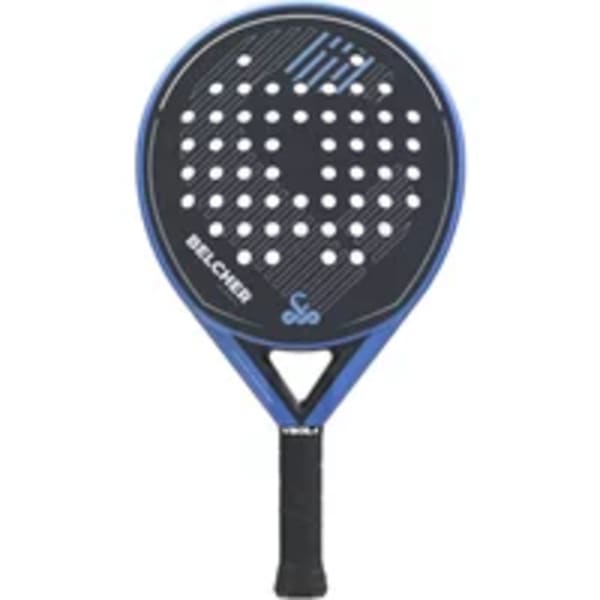
Vibora Belcher Classic Fiber
✓Cross-checked with official data from Viborahow we score
PADELTESTLAB SCORE
0-100 scale
79/100
Price range
Description
Who this racket is for
Pros
- ✓The wide sweet spot of the round shape bails out shots struck near the frame — a common issue when your timing on volleys and bandejas isn't dialled in yet The fibreglass face is springy and sends the ball back with minimal effort: in long defensive rallies and lobs from the back you don't need to muscle the shot yourself The soft EVA core cushions the impact and cuts down the vibration reaching your elbow, a real factor for players putting in several hours on court every week The head-light balance keeps the weight near your hand so the racket arrives on time in fast net exchanges, exactly where beginners tend to be a split-second late This is a control racket: on wall exits and balls played at your feet the flat face holds its line and keeps the trajectory predictable
Cons
- ✗The fibreglass-plus-soft-EVA combo caps out on the smash: when you go for the winner, the ball leaves with less pace than a point-closing shot demands The smooth surface generates little bite, so cut viboras and kick serves with lateral spin come out flat The head-light balance takes inertia away from the flat smash and the long bandeja — you have to supply the arm speed yourself because the racket won't carry through A player who nails down their technique will outgrow it within months; it's built for learning, not for keeping pace with intermediate-level progress
PADELTESTLAB SCORE
0-100 scale
79/100
It is at its lowest price since we started tracking it: €49.95, down from €118.98. We began recording on March 23.
Prices recorded daily since March 23 · 58 days of data
Vibora Belcher Classic Fiber Review: The Brand's Round-Shape Entry Point
Some padel rackets are built to win points, others are built to teach you how to play them. The Vibora Belcher Classic Fiber sits firmly in the second camp: round shape, fibreglass face, soft EVA core and head-light balance. Four construction choices all pulling in the same direction — get the ball back over the net even when your contact point isn't clean yet.
This isn't a signature model or an upgrade of an older release. It's the brand's beginner racket, and it deserves to be judged on exactly that basis.
Who should actually buy the Vibora Belcher Classic Fiber?
Beginners still building their technique: social matches, two or three hours a week on court, contact point still inconsistent. The round shape puts the sweet spot at the geometric centre of the face and widens it, so an off-centre hit still clears the net instead of dying in it.
That's the real buying criterion at this level — not maximum power, but how many of your mishit balls stay playable.
Specs at a glance
| Spec | Detail |
|---|---|
| Shape | Round |
| Balance | Head-light |
| Face | Fibreglass |
| Core | Soft EVA |
| Surface | Smooth |
| Level | Beginner |
| Play style | Control |
Fibreglass face and soft EVA core: what this combo actually does
Fibreglass is a springier material than carbon. It flexes more on impact and returns that flex as forward push, which in practice means the racket does the work for you — you don't need serious arm acceleration to send the ball across the court.
The soft EVA core pulls in the same direction. A soft foam compresses more on contact, keeps the ball on the face a fraction longer, and takes the edge off the vibration spike that travels up the handle to your elbow. For anyone still swinging with a stiff wrist or getting to the ball late, that cushioning is injury prevention, not a nice-to-have.
The trade-off is well known: flex and softness deliver ball exit, not top-end speed. This racket gets the ball out easily — it doesn't fire it.
Shot-by-shot: how it actually plays
Defence and wall exits. This is where it makes its strongest case. The ball comes off the wall, you meet it with the flat face, and the lob goes deep without any extra effort on your part. The head-light balance combined with the springy face means you get there in time and the ball doesn't fall short.
Volley. Weight concentrated near the hand shortens your reaction time in fast net exchanges. The block volley comes out clean; the aggressive volley is a bit shorter on depth.
Bandeja. Works well in the short, placement-focused version. The long bandeja aimed at the back of the court needs head inertia that a head-light balance simply doesn't provide, so you'll have to supply the swing yourself.
Smash and vibora. This is its ceiling. The point-closing smash comes out with limited pace — the soft foam absorbs energy instead of returning it, and fibreglass lacks carbon's crisp response. The smooth surface also grips the ball poorly, so cut viboras and kick serves with lateral bite lose much of their effect.
Control racket or power racket?
Control, no question. The smooth surface, head-light balance and soft core all point toward precision and comfort. Trajectories stay predictable, the ball doesn't run away from you on long shots, and unforced errors drop. In exchange, closing out a point with one shot is rarely going to be on the table with this racket.
Who it suits — and who to pair it with
Best fits:
- Beginners who need a racket that forgives off-centre contact.
- Players managing elbow or wrist issues who prioritise cushioning.
- Social players more focused on keeping the rally alive than finishing it.
It's not the right call for an intermediate player with settled technique chasing ball speed, or for anyone building their game around the smash.
As a doubles pairing, it works well alongside a more aggressive partner: you sustain the rally, they finish it. That's a fair division of labour for a player just starting out.
Verdict: does exactly what it promises, no more
The Vibora Belcher Classic Fiber is a well-executed beginner padel racket. The wide sweet spot, natural ball exit and soft-core cushioning cover the three things a learning player actually needs, and the head-light balance means the racket practically handles itself at the net.
Its limits are structural, not manufacturing flaws: limited smash pace, little spin off the smooth surface, and low inertia on baseline shots. None of that matters while you're still building technique — all of it starts to matter the moment you have.
Buy it if your priority is learning without punishing your arm, and without every mishit costing you the point. Skip it if you're already playing with intent and can feel the ball isn't leaving the face as fast as you're swinging it.
In the brand's lineup
Within vibora's lineup, the belcher classic fiber is one of the most accessible options starting at €49.95, perfect for getting started without a heavy outlay. With an overall score of 79/100, it's a solid choice within its price range.
Frequently asked questions
Who is the Vibora Belcher Classic Fiber for?
The Vibora Belcher Classic Fiber is built for beginner level: easy to handle and forgiving. Not the ideal pick if you already have consolidated technique.
What's the Vibora Belcher Classic Fiber's PadelTestLab score?
The Vibora Belcher Classic Fiber scores 79/100 in our review, based on power, hardness, control, maneuverability, ball exit, sweet spot and surface roughness.
How much does the Vibora Belcher Classic Fiber cost?
Current price of the Vibora Belcher Classic Fiber is 49.95€ – 94€, comparing 3 shops in our finder.
Similar alternatives
Other rackets with a similar profile and price range: