StarVie Polaris
✓Cross-checked with official data from StarViehow we score
PADELTESTLAB SCORE
0-100 scale
80/100
Price range
Description
Who this racket is for
Pros
- ✓The S-Eva Flex core and low balance mean the ball comes off the face without you having to force it: on low wall exits and emergency lobs you get back metres that a stiffer, head-heavy racket would leave in the net. The teardrop's sweet spot is wide and sits slightly forward, so volleys struck near the frame still come out with direction instead of dying on the racket face. At 350-366 grams with the Geo Air Core internal structure, quick hands at the net and switching from backhand volley to bandeja happen without any lag in preparation. The rough surface paired with Spin Boost Tech grips well on the lifted lob and the víbora: kick shows up even at moderate arm speed. The 38 mm frame with soft rubber keeps a cushioned feel through long matches, which is a real plus if your elbow or shoulder start complaining after two hours on court.
Cons
- ✗The power ceiling arrives early: on a flat smash down the third the racket goes along for the ride but doesn't add anything, and against opponents who defend well you'll end up replaying the point more than once. The low balance takes away inertia on the high bandeja; if you don't commit body and leg weight, the ball falls short and you hand the opponent the net. The fibreglass-and-soft-core combo loses precision once you really open up: on tight down-the-line shots at high pace the ball tends to run long. The heavily cushioned feel filters out impact feedback, which costs you on dropshots and fine cuts, where you need to feel exactly where the ball meets the face.
PADELTESTLAB SCORE
0-100 scale
80/100
It is down 38% from its highest price: from €139.95 to €86.95. Tracked since March 20.
Prices recorded daily since March 20 · 120 days of data
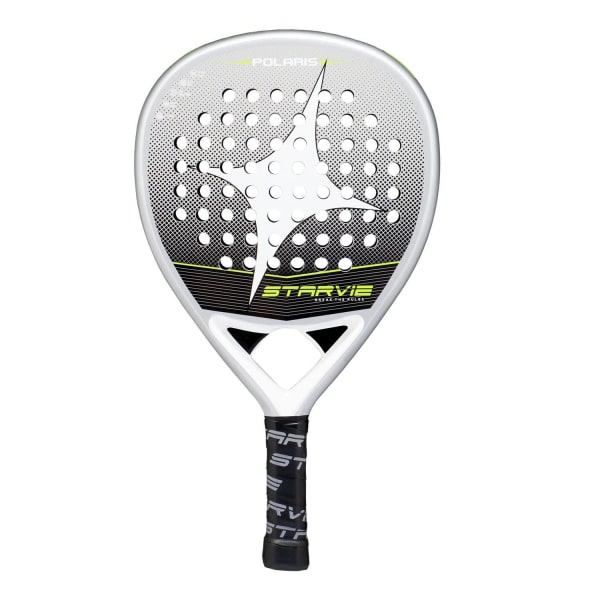
The StarVie Polaris is built around one very specific idea: getting the ball off the face with minimal effort. X-Glass Tech fibreglass on the face, an S-Eva Flex core, 350-366 grams and a low-balance teardrop shape over a 38 mm frame.
It's a package aimed at players who don't yet generate their own arm speed and need the racket to do part of the work for them. Nothing about this padel racket is designed to punish mishits.
What X-Glass Tech, S-Eva Flex and Geo Air Core actually bring to your game
Fibreglass is a more elastic surface than carbon. It flexes more on impact and returns that flex as ball exit, which on court means less effort needed to reach the back wall.
The trade-off is well known: it filters feedback. You feel the exact contact point less, and that costs you finesse on touch shots.
The S-Eva Flex core pulls in the same direction. A soft core widens the usable hitting zone and dampens vibration, but it compresses too much when the shot comes in fast, and that's the point where the racket stops responding and starts rebounding unpredictably.
Geo Air Core is an internal geometric structure built for maneuverability: the racket weighs what it weighs, but swings like it weighs less because mass isn't stacked in the head. Combined with Spin Boost Tech and the rough face, the racket's character is fully defined: control, grip and ease of use over raw power.
What level of player is the StarVie Polaris built for?
The Polaris is designed for beginners and players in the middle of technical progression. Its low balance, soft core and wide sweet spot cut down the punishment for off-centre hits and make ball exit easier, letting the player focus on positioning and footwork without depending on an already-polished stroke.
StarVie Polaris: full specs
| Spec | Value |
|---|---|
| Shape | Teardrop |
| Balance | Low |
| Weight | 350-366 g |
| Face | Fibreglass (X-Glass Tech) |
| Core | Soft EVA (S-Eva Flex) |
| Frame | 38 mm |
| Surface | Rough |
| Playstyle | All-round |
| Level | Beginner / progression |
| Technologies | X-Glass Tech, S-Eva Flex, Geo Air Core, Spin Boost Tech |
Shot by shot: where it shines and where it falls short
Defence and wall exits. This is where the racket earns its keep. The soft core compresses and releases the ball without needing extra swing, so the emergency lob comes out deep even when you're rushed and off-balance. Balls stuck to the back glass that would normally stay in the corridor now clear the net.
Volleys. The wide sweet spot does quiet, effective work: volleys hit high on the face or near the frame edge still hold their line. On the flip side, blocking a very fast ball produces more rebound than you'd like, and you need to consciously close the face.
Bandeja and víbora. The teardrop shape shifts the sweet spot slightly toward the head, which helps you make contact higher up without needing to find dead centre. The rough surface bites into the ball well: the víbora comes out with genuine sidespin, not a watered-down version. The high bandeja, though, demands technique and legwork, because the low balance offers no extra inertia and the ball tends to fall short mid-court if the shot is arm-only.
Smash. The flat smash down the third comes out clean and controlled, but without that extra sting a stiffer, head-heavy racket delivers. Against pairs who defend well, you won't close out the point on the first attempt.
The real ceiling on this StarVie option
The same behaviour that makes this racket easy is what holds it back. Once a player starts generating real arm speed, the fibreglass and soft core stop supporting the ball: precision drops on long down-the-line shots, and the racket starts to feel like it's a beat late returning energy.
This is a design limitation, not a manufacturing flaw, and it's worth knowing before you buy: the Polaris is built to accompany one specific stage of the learning curve.
Who it suits and what pairing works best
- **Beginners** who need to reach the back wall without straining the shoulder.
- **Progressing players** who already position well but don't yet hit hard, and want a racket that lets them work on lifted shots and wall exits.
- **Players managing joint discomfort** who want a cushioned feel through long matches.
As a doubles pairing, it works well alongside a partner with a more head-heavy racket who takes on the finishing smash, while the Polaris user sustains the rally, lifts deep lobs and works the net.
Verdict: honest ease of use
The StarVie Polaris delivers exactly what its spec sheet promises and doesn't try to be anything else: an all-round, soft, manageable racket with above-average ball exit for its category and a low power ceiling.
If you're after one-shot point finishers, this isn't the racket. If you want to play more balls, cut down unforced errors and walk off court without elbow pain, it does its job reliably.
In the brand's lineup
Within StarVie's lineup, the Polaris is one of the most accessible options starting at €86.95, perfect for getting started without a heavy outlay. Its overall score of 80/100 places it among the best all-round rackets we've reviewed.
Frequently asked questions
Who is the StarVie Polaris for?
The StarVie Polaris is built for beginner level: easy to handle and forgiving. Not the ideal pick if you already have consolidated technique.
How much does the StarVie Polaris weigh?
The StarVie Polaris weighs 350-366g according to the manufacturer's stated specs.
What's the StarVie Polaris's PadelTestLab score?
The StarVie Polaris scores 80/100 in our review, based on power, hardness, control, maneuverability, ball exit, sweet spot and surface roughness.
How much does the StarVie Polaris cost?
Current price of the StarVie Polaris is 86.95€ – 189.95€, comparing 4 shops in our finder.
Similar alternatives
Other rackets with a similar profile and price range: