Softee Oxel
✓Cross-checked with official data from Softeehow we score
PADELTESTLAB SCORE
0-100 scale
78/100
Price range
Description
Who this racket is for
Pros
- ✓The 3K carbon faces give a firm, fast response on the smash by 3 and on the vibora, with the ball jumping off the face when you meet it head-on The Soft EVA core cushions centred, arm-draining shots, which pays off on repeated bandejas and in long matches The reworked anti-vibration bridge cuts down the sharp jolt to the elbow on off-centre hits toward the sweet spot The teardrop shape with medium balance still lets the racket turn quickly on reaction volleys without losing the mass that drives the flat smash The smooth hitting surface delivers a clean touch off the back wall, so the ball doesn't grab and comes off on a predictable line
Cons
- ✗The smooth face limits cut and slice on the bandeja and the dropshot: players who live off kick and bite on the ball will feel this racket doesn't grip Ball exit is understated for how much pop this racket offers: if you don't put your arm into it, shots fall short and you have to generate all the pace yourself The sweet spot isn't especially forgiving; hits toward the tip or the throat lose noticeable pace compared to a centred strike With no published weight or balance-in-millimetres figures, fine-tuning the racket (overgrips, protector) comes down to trial and error
PADELTESTLAB SCORE
0-100 scale
78/100
It is at its lowest price since we started tracking it: €105.95, down from €183.50. We began recording on March 20.
Prices recorded daily since March 20 · 125 days of data
Softee Oxel review: a 3K carbon teardrop with a soft heart
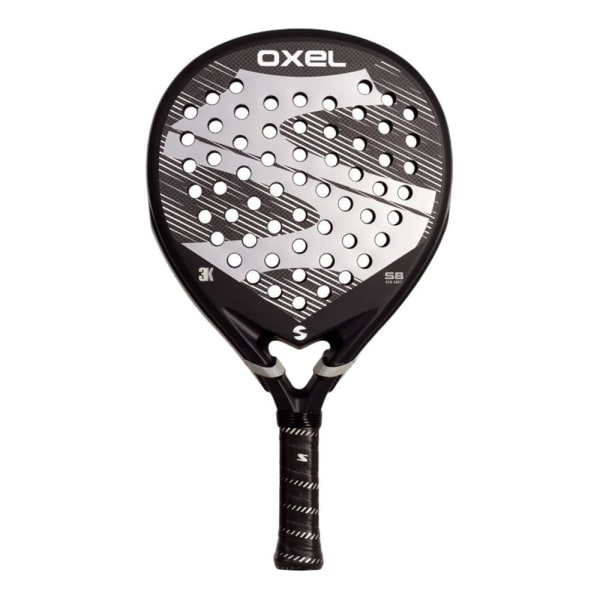
The Softee Oxel tackles an equation almost no power racket attempts: rigid 3K carbon faces over a Soft EVA core, teardrop shape, medium balance, and a redesigned bridge built to cut vibration. The result isn't a control racket in disguise — it's a power racket that doesn't punish your arm.
Who should actually be playing with the Softee Oxel?
Advanced players. Not because it's harsh — the Soft EVA is the opposite of that — but because this racket needs arm speed to perform. Ball exit is restrained: the ball won't leave the face on its own, you have to drive it. A mid-level player who just makes contact will find shots falling short, dying in the middle of the court.
In the hands of someone who generates their own racket-head speed, that same trait becomes precision: the ball goes where you send it and doesn't fly long off a blocked volley.
3K carbon over Soft EVA: what this pairing actually does on court
3K carbon is an open-weave fabric. Compared with denser weaves, it delivers stiffness with a touch more surface flex, so the face doesn't play like a board — there's a millimetre of give before the rebound, which stretches out the contact time.
Underneath, the Soft EVA core absorbs the impact rather than firing it straight back. That has two practical effects.
- On the flat smash the ball comes off fast, because the rigid face does the rebound work.
- On high defensive shots and repeated overhead balls, your arm finishes the match in better shape than a typical power racket would leave it.
The redesigned anti-vibration bridge ties it together. On off-centre hits toward the throat — the shots that transmit the most vibration — what reaches the elbow is filtered.
| Spec | Value |
|---|---|
| Shape | Teardrop |
| Balance | Medium |
| Face | 3K Carbon |
| Core | Soft EVA |
| Surface | Smooth |
| Level | Advanced |
| Playstyle | Power |
| Technology | Redesigned anti-vibration bridge |
Shot by shot: where the Oxel shines, and where it falls short
Smash by 3 and flat smash. This is the racket's whole case. The teardrop shape stacks mass ahead of the grip without going full diamond, and the 3K faces send the ball back with real pace. The flat smash aimed at the back wall is this padel racket's signature shot.
Bandeja. Solid on direction and height, quiet on spin. The smooth hitting surface doesn't bite into the ball: the bandeja comes out flatter than you'd like, and kick only shows up with a very clean technique. Players who build their defensive game around cut bandejas and sliced viboras will hit a ceiling here.
Vibora. Better than the bandeja, because the vibora relies on pace as much as spin, and here the rigid face supplies the pace.
Ball exit off the back wall. Strong performance. The ball doesn't snag on the smooth surface and comes off on a predictable line — a real asset when you're stretched and can only guide the shot.
Volley. Medium balance lets you turn the racket quickly on a block volley. The controlled ball exit works in your favour too: blocked volleys stay in rather than sailing long.
Defence and lob. The weak point. With that restrained ball exit, a deep lob from the back of the court needs a full, committed swing; flick it with just the wrist and it falls short, handing over the net.
The sweet spot: what to know before you buy
The Softee Oxel's optimal response area is medium-sized and clearly defined. Centred contact rewards you with pace and a clean feel; hits toward the tip or the throat lose noticeable ball speed.
This isn't a manufacturing flaw but the logical trade-off of a teardrop with rigid faces: energy concentrates where the mass sits. An advanced player with consistent contact will make the most of it; an inconsistent one will feel it on every other shot.
What type of player does this Softee racket suit?
The attacking player with fast hands who's ruled out hard rackets because of elbow or shoulder trouble. That's the specific niche: they want to hit hard, but a hard EVA racket no longer works for their body.
As part of a pair, it works better on the backhand side — the position that smashes by 3 and closes out at the net — than on the forehand, where bandeja play and containment matter more and the smooth surface limits your spin options.
This isn't a racket for players who want the racket to do the work: restrained ball exit means you have to supply the engine yourself. Nor is it for players whose game is built on cut and slice, given the lack of texture on the face.
Verdict
The Softee Oxel nails its concept — power without harshness — and executes it coherently: 3K carbon for rebound, Soft EVA for comfort, an anti-vibration bridge for the arm. The finish is understated, in matte metallic grey.
What you trade off in return: limited spin from the smooth surface, demanding ball exit, and a sweet spot that rewards precision. If your game is flat, vertical, and built around pace without paying for it in your elbow, this equation works in your favour. If you live off slice and a biting bandeja, this isn't your racket.
In the brand's lineup
Within Softee's lineup, the Oxel occupies the mid-range starting at €105.95, offering highly competitive value for its segment. With an overall score of 78/100, it's a solid choice within its price range.
Frequently asked questions
Who is the Softee Oxel for?
The Softee Oxel targets advanced players. It needs consolidated technique and is not recommended for beginners.
What's the Softee Oxel's PadelTestLab score?
The Softee Oxel scores 78/100 in our review, based on power, hardness, control, maneuverability, ball exit, sweet spot and surface roughness.
How much does the Softee Oxel cost?
Current price of the Softee Oxel is 105.95€ – 190.71€, comparing 5 shops in our finder.
Similar alternatives
Other rackets with a similar profile and price range: