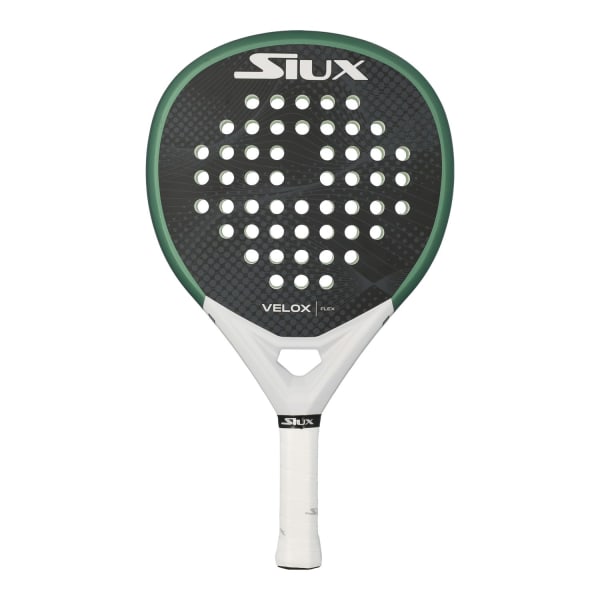
Siux Velox Flex Verde Fibra De Vidrio
✓Cross-checked with official data from Siuxhow we score
PADELTESTLAB SCORE
0-100 scale
78/100
Description
Who this racket is for
Pros
- ✓The Medium EVA core with Mid Touch soaks up impact and sends the ball back deep with almost no effort — on awkward volley blocks and defensive returns it just floats off the face without you having to speed up your swing The fiberglass face gives a soft touch and predictable response that makes controlling wall exits far easier, a shot where stiff carbon faces tend to spray the ball long The medium-high balance keeps mass up in the head, delivering real punch on smashes and bandejas from the back court — not something you usually get on a racket that's also friendly to newer players The teardrop shape paired with Optimized Spot widens the sweet spot into a generous, accessible zone: mishit backhand volleys still come off with decent pace The 350-375g weight range lets you pick a lighter build for extra maneuverability at net or a heavier one for more thump from the back, all in the same model
Cons
- ✗That medium-high balance costs you on defense: get caught late on a deep bandeja or a cross-court globo and it's hard to whip the racket face back into position before the ball arrives
PADELTESTLAB SCORE
0-100 scale
78/100
Out of stock right now
None of the shops we track has it in stock right now.
See similar rackets in stockSiux Velox Flex Verde review: the soft teardrop racket that forgives your mistakes
The Siux Velox Flex Verde is a teardrop-shaped padel racket with a smooth fiberglass face, a Medium EVA core, and a weight range spanning 350 to 375 grams. Medium-high balance, Mid Touch and Optimized Spot technology, and an all-round personality that refuses to fully commit to pure control or raw power.
That combination is rarer than it looks. Most head-heavy teardrops pair stiff carbon faces with firm rubber to maximize pop. Siux does the opposite here: keep the mass up top, soften everything else.
Why pair fiberglass with a Medium EVA core?
Fiberglass is more flexible than carbon fiber. It flexes more on contact, returns more energy, and sends less vibration up your arm. The trade-off is that it gives an experienced player less tactile feedback for reading the shot.
The Medium EVA core, branded Mid Touch by Siux, points in the same direction. It's not a rubber you need to break with fast arm speed — it responds well to medium-pace hitting and sends the ball back deep without demanding extra acceleration.
On court that translates into a padel racket with very generous ball exit. Block a forehand volley with a firm face and the ball drops deep almost on its own. That's exactly what an intermediate player still building full power through technique needs.
Optimized Spot and teardrop shape: where's the sweet spot?
The teardrop shape sits the sweet spot in the middle ground between round and diamond — not as low and wide as a round racket, not as high and narrow as a pure attacking shape.
Optimized Spot works that zone to widen it further. In practice that means tolerance: contacts that land slightly off-center — think a rushed backhand volley or a stretched defensive return — don't die on the face.
This isn't the huge, blanket-forgiving sweet spot of a true beginner racket. It's a wide, well-defined core that rewards decent contact and still lets you know when you've badly mishit it.
Siux Velox Flex Verde: full specs
| Spec | Value |
|---|---|
| Shape | Teardrop |
| Weight | 350-375 g |
| Balance | Medium-high |
| Face | Fiberglass |
| Core | Medium EVA |
| Surface | Smooth |
| Technology | Mid Touch, Optimized Spot |
| Level | Intermediate |
| Playstyle | All-round |
Shot-by-shot breakdown
Smash. The medium-high balance earns its keep here. There's enough head mass for a flat smash to carry real pace, though fiberglass won't give you the crisp, dry response of a carbon face. The ball comes off fast, but with less of that whip-crack feel.
Bandeja. This is where the racket really shines. Head weight stabilizes the face through the lateral contact, and the soft rubber lets you dial in height without the ball flying long. Probably its best transition shot.
Vibora. The real limitation. With a smooth face you can still slice and add spin through technique, but the surface offers no extra grip. Next to a rough-textured racket, the spin you generate is noticeably less.
Wall exit. The standout shot. The Medium EVA core and fiberglass face soak up a ball coming dead off the glass and send it back deep. Shots that would fall short off a stiffer racket reach the baseline here.
Defense and lobs. Time for honesty. The medium-high balance works against you when you're rushed. A deep cross-court globo forces you to set up earlier than you would with a low-balance racket, and if you're late, the head lags behind the ball.
Who is this Siux racket built for?
An intermediate, all-round player who wants pop from the baseline without giving up defensive solidity. The typical profile: someone who already comes to net with purpose, strings bandejas together, and finishes smashes on a high ball — but doesn't yet generate enough raw power to make the most of a stiff rubber.
The 350-375g weight range gives you two reads on the racket. At 350g it's a nimble net racket, quick through the volley and less punishing in defense. At 375g it adds real weight from the back but sharpens the medium-high balance's downside on rushed shots.
The player least likely to love it is the fast-armed advanced type chasing a crisp, dry response and pinpoint spin control. The smooth face and medium rubber will feel muted to that kind of game.
Three quick questions
- **Good for beginners?** Yes, especially the lighter build. The wide sweet spot and generous ball exit forgive off-center contact.
- **Is this a power racket?** Not purely. It's all-round with a power lean thanks to the balance, but the fiberglass face softens the impact.
- **Can it handle an aggressive game?** To a point. It smashes well, but a player who lives off heavy vibora spin will miss the grip a textured face provides.
Verdict: plenty of free depth in exchange for less spin
The Siux Velox Flex Verde solves a specific problem: giving power to players who can't yet generate it on their own, without beating up their arm or demanding a perfect strike every time. The medium-high balance teardrop puts mass where it counts, and the fiberglass face with Medium EVA core handles the rest.
There's a two-part cost. You lose spin because of the smooth face, and you lose tactile feedback because of the overall flex. If your game is built around heavy vibora spin and cut drop shots, this isn't your racket.
But if what you need is a padel racket that sends the ball back deep from almost any position while you're still grooving your technique, this one delivers.
In the brand's lineup
Within Siux's lineup, the Velox Flex Verde positions itself as a distinctive alternative. With an overall score of 78/100, it's a solid choice within its price range.
Frequently asked questions
Who is the Siux Velox Flex Verde Fibra De Vidrio for?
The Siux Velox Flex Verde Fibra De Vidrio fits the intermediate level. Suited to players with a technical base who want to progress without jumping to a competition racket.
How much does the Siux Velox Flex Verde Fibra De Vidrio weigh?
The Siux Velox Flex Verde Fibra De Vidrio weighs 350-375g according to the manufacturer's stated specs.
What's the Siux Velox Flex Verde Fibra De Vidrio's PadelTestLab score?
The Siux Velox Flex Verde Fibra De Vidrio scores 78/100 in our review, based on power, hardness, control, maneuverability, ball exit, sweet spot and surface roughness.
Similar alternatives
Other rackets with a similar profile and price range: