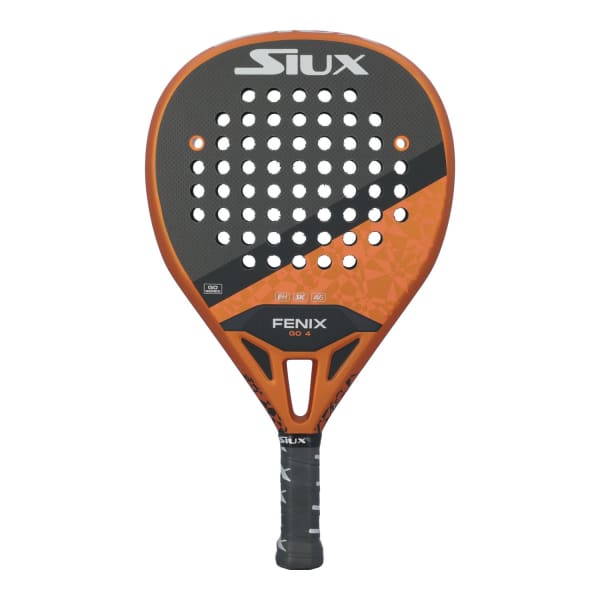
Siux Fenix Go 4
✓Cross-checked with official data from Siuxhow we score
PADELTESTLAB SCORE
0-100 scale
78/100
Price range
Description
Who this racket is for
Pros
- ✓Pairing EVA Hard with 3K carbon means the ball comes off the face without sinking: on flat smashes and por-3 smashes the exit is fast and downward, none of that soft rebound that drags points out The Dampeners Shockout soak up some of the vibration a core this dense generates, which you'll appreciate through long sessions of fast volleys against low, tight balls The 360-375 gram weight puts real mass behind the bandeja: the ball goes deep without needing extra arm speed, as long as you set your shoulder up early Despite being pitched as a power racket, it responds with very clean directionality on block volleys and low flat balls at your feet
Cons
- ✗Ball exit is short: defending from the back, on a dead ball off the wall, you need full arm swing because the EVA Hard gives nothing back on its own The sweet spot is tight and the hard feel amplifies mishits: a ball taken near the frame on serve return comes off shallow with a jarring sensation in the wrist The smooth face limits bite on cut shots: the vibora comes out flatter and less "grabbed," and the kick loses lateral bounce At 375 grams in the high hand, fast net-volley exchanges punish players whose reactions aren't razor sharp
PADELTESTLAB SCORE
0-100 scale
78/100
It is at its lowest price since we started tracking it: €64.95, down from €99.95. We began recording on March 20.
Prices recorded daily since March 20 · 81 days of data
Siux Fenix IV Go Review: EVA Hard, 3K Carbon and 375 Grams That Give You Nothing for Free
The core of the Siux Fenix IV Go defines this racket before anything else: EVA Hard, a smooth 3K carbon face, a weight range of 360 to 375 grams, and Dampeners Shockout as the sole cushioning system between ball and elbow. It's a power padel racket aimed at intermediate players, and the nuance matters here — this is power built into the materials, not power handed to you.
What do 3K carbon and EVA Hard actually bring to this racket?
3K carbon uses a relatively open filament weave. Compared to tighter-weave fabrics, it delivers a slightly more elastic, less glassy response, which softens the impact without turning the face into a trampoline.
That touch of elasticity is exactly what the EVA Hard core underneath needs. A hard rubber barely deforms on contact: it compresses very little, rebounds fast, and transmits a lot. Minimal compression means the ball leaves the face almost instantly, on a tense trajectory with very little dwell time.
That's where the Dampeners Shockout come in. Their job is to absorb the residual vibration a core this dense sends up into your grip, especially on off-centre hits. They don't make the racket plush, but they do cut down fatigue over long matches.
Siux Fenix IV Go specs at a glance
| Spec | Value |
|---|---|
| Weight | 360-375 g |
| Face | 3K Carbon |
| Core | EVA Hard |
| Surface | Smooth |
| Technology | Dampeners Shockout |
| Play style | Power |
| Recommended level | Intermediate |
Shot by shot: where it delivers and where it punishes
The flat smash is where this racket shows its best side. The hard rubber doesn't sink under a heavy impact, so the ball exits fast with downward trajectory — none of that cushioning effect that sends the ball up high and lets your opponent reset. The por-3 smash feels the same: crisp, short, final.
The bandeja benefits from the weight. At 375 grams there's enough mass to send the ball deep without accelerating your arm, which keeps depth consistent as the match wears on. It does demand early preparation, though.
The vibora is more debatable. With a smooth surface, bite on the felt is limited, and the shot comes out flatter and more direct rather than grabbed. It's good for speeding up the cross-court ball, less so for generating that nasty lateral kick.
Where the Fenix IV Go costs you is in defence. Ball exit is among the shortest in its category: on a dead ball off the back wall, or a lobbed defensive shot from deep with little time to react, there's no help coming from the racket. Either the player supplies the push, or the ball falls short.
Why does a racket labelled "power" feel so controlled?
Short answer: because its power is conditional. EVA Hard delivers huge ball speed when you strike it centred with an accelerated arm, but gives back very little on passive shots. The result is a padel racket that feels precise and directional in block-volley exchanges, and explosive only when the player supplies the force.
That's the key to understanding this model: it's not a forgiving racket, it's a multiplying one. It multiplies good contact just as much as bad contact, because the sweet spot is tight and a ball taken near the frame registers immediately in the wrist.
Who is this Siux racket really for?
The Siux Fenix IV Go calls for an intermediate player with technique already dialled in, not someone fresh out of beginner lessons. Specifically:
- **Flat, aggressive net game.** If your pattern is to move up, close out points with a smash and avoid long rallies, this racket has your back.
- **A trained arm with no elbow history.** The hard feel is real; anyone carrying epicondylitis issues should look toward softer cores.
- **Tolerance for weight.** 360-375 grams isn't neutral — it tires the hand and slows your reactions at the net.
As a doubles pairing, it works best alongside a partner who builds the point patiently, leaving this racket to play the finisher's role. Two hard, heavy rackets on the same court tend to come up short on defence.
Verdict: power you have to earn
The Fenix IV Go delivers on its promise, with one big condition attached. The materials are all pulling in the same direction — 3K carbon, EVA Hard, Shockout dampening — and the result is a padel racket that hits crisp, directs well, and finishes points fast.
In return, it demands plenty. It demands centred contact, it demands arm speed, and it demands good timing. Players hoping for a racket that bails them out of tough defensive balls will get frustrated with this one; those wanting a finishing tool that won't sink on impact will find exactly what they're after.
If you're torn between this Siux and something more all-round, the real question isn't how much power you want — it's how much you're willing to bring yourself.
In the brand's lineup
Within Siux's lineup, the Fenix IV Go is one of the most accessible options starting at €64.95, perfect for getting started without a heavy outlay. With an overall score of 78/100, it's a solid choice within its price range.
Frequently asked questions
Who is the Siux Fenix Go 4 for?
The Siux Fenix Go 4 fits the intermediate level. Suited to players with a technical base who want to progress without jumping to a competition racket.
How much does the Siux Fenix Go 4 weigh?
The Siux Fenix Go 4 weighs 360-375g according to the manufacturer's stated specs.
What's the Siux Fenix Go 4's PadelTestLab score?
The Siux Fenix Go 4 scores 78/100 in our review, based on power, hardness, control, maneuverability, ball exit, sweet spot and surface roughness.
How much does the Siux Fenix Go 4 cost?
Current price of the Siux Fenix Go 4 is 64.95€, comparing 2 shops in our finder.
Similar alternatives
Other rackets with a similar profile and price range: