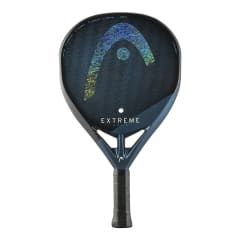
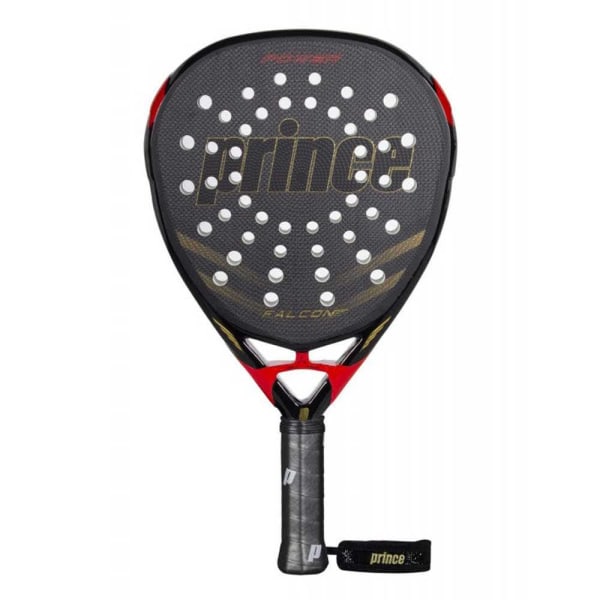
Prince Falcon
✓Cross-checked with official data from Princehow we score
PADELTESTLAB SCORE
0-100 scale
80/100
Description
Who this racket is for
Pros
- ✓The Triple Threat sandwich (outer fibreglass, 24K carbon in the middle, 3K carbon on top) piles on power without turning rock-hard: the smash off the third bounce comes off with a ball exit that's surprisingly lively for such a dense EVA Power core The diamond shape with head-heavy balance stacks mass up top and multiplies inertia on the flat smash and the crossed vibora, where the racket does half the work for you The 38 mm frame with Aero Profile cuts through the air on the long swing of the smash: it takes less effort to accelerate the head through the final phase of the shot The rough surface bites into the ball on the pinchada and the cut bandeja, an effect you'll really notice when you're trying to kill the bounce against the back glass A 355-370 g weight range gives you room to pick a lighter build and dial back some of the physical demand of that head-heavy balance without losing the power profile
Cons
- ✗The sweet spot is narrow and sits high toward the top of the face: ball contact in the middle or lower on the racket comes out short and sends a sharp jolt through the forearm The head-heavy balance forces you to prepare well in advance on defence; on low, fast wall exits the head feels heavy and you arrive with the racket lagging behind The EVA Power core demands your own arm speed: if you don't generate pace, the rubber doesn't compress and gives back less than the power profile promises Maneuverability on quick net blocks and reflex volleys trails behind an equivalent round-shaped racket; in short exchanges you need to play with your body, not your wrist
PADELTESTLAB SCORE
0-100 scale
80/100
Out of stock right now
None of the shops we track has it in stock right now. We last saw it on August 2 at €119.98.
See similar rackets in stockPrince Falcon Review: Explosive Power in a Diamond-Shaped Padel Racket
The Prince Falcon dropped in 2022 with one clear brief inside Prince's lineup: be the most powerful racket in the collection. Diamond shape, head-heavy balance, a 38 mm frame and a face built from three layers — fibreglass, 24K carbon and 3K carbon — under the Triple Threat name. The core is a firm EVA Power. Weight sits between 355 and 370 grams.
This isn't a transition racket, and it isn't built to forgive. It's an advanced-player tool for someone who already knows how to smash and wants the racket to amplify what they do, not correct it.
Triple Threat Explained: Why Three Face Layers Instead of One
Most power rackets settle for a straight carbon face. The Prince Falcon stacks three materials, each doing a different job.
The outer fibreglass adds a touch of give on first contact, which is exactly what stops a firm EVA Power core from feeling completely dead. The 24K carbon in the middle supplies the structure and directional stiffness — it's the layer that keeps the face from flexing when you really lean into a shot. The 3K carbon on top rounds things off with a lighter, tighter weave.
On court, the result is a crisp feel without being harsh. The ball doesn't sit on the strings — it's off fast, and the response feels the same on shot one as it does on shot forty of the match.
The Power Core works alongside that EVA Power to keep compression concentrated under the high-impact zone, right where the head-heavy balance carries the mass. And the Aero Profile on the 38 mm frame cuts down air resistance through the swing — most noticeable on the flat smash, where the stroke is long and that final burst of acceleration is the difference between a smash that bounces back and one that goes out the side.
Prince Falcon Specs
| Spec | Detail |
|---|---|
| Shape | Diamond |
| Weight | 355-370 g |
| Balance | Head-heavy |
| Face | 24K carbon + 3K carbon fibre + fibreglass (Triple Threat) |
| Core | EVA Power (firm) |
| Frame | 38 mm |
| Surface | Rough |
| Technologies | Triple Threat, Aero Profile, Power Core |
| Level | Advanced |
| Playstyle | Power |
| Year | 2022 |
How Does the Prince Falcon Perform Shot by Shot?
On the smash, this is where the racket earns its keep. The diamond shape with head-heavy balance loads mass into the top third, and paired with the 38 mm frame, it builds inertia that does half the work for you. The flat smash comes off heavy. On the smash off the third bounce, the stiffness of the 24K carbon keeps the face from folding, so the ball holds the line you gave it.
On the vibora and bandeja, the rough surface takes over. It grips the ball enough to produce real spin, not just cosmetic bite. The cut bandeja dips nicely, and the crossed vibora comes off with pace and spin — but only if you catch it high, since this racket's sweet spot is narrow and sits near the top.
On defence and wall exits, the trade-off shows up. The head-heavy balance means you need to set up earlier than you're used to. If the ball catches you tight to the glass with little height, the head feels heavy and the shot comes out forced. The defensive lob works fine when you're there in time — if you're just barely there, the racket won't bail you out.
At the net, you need to play with your shoulder and body, not your wrist. Reflex blocks are the weakest part of the package, which is par for the course with a diamond shape of this profile.
Who Should Actually Play With This Prince Racket?
The Prince Falcon is built for advanced, competitive players. It asks for three things: enough arm speed to compress the EVA Power core, consistent striking technique to find a narrow sweet spot, and the physical conditioning to handle a head-heavy balance for a full match.
The player who gets the most out of it is the attacking net player who steps in and finishes points — someone who smashes more than they build and looks to close things out in two or three shots. If your game leans on patience, high balls and grinding out rallies, there are more forgiving options out there.
As a doubles pairing, it works well alongside a more controlling partner who can hold down the longer rallies while the Falcon's user hunts for the smash.
Prince Falcon: The Good, the Bad, and Who It's For
What it gets right:
- Genuine power on the smash and vibora, backed by diamond-shape inertia and the stiffness of the 24K carbon.
- Ball exit that outperforms expectations for such a firm core, thanks to the fibreglass layer.
- Consistent spin off the rough surface, useful on both the cut bandeja and the pinchada.
- A wide weight range (355-370 g) for tuning the physical demand to suit you.
What it costs you:
- A narrow sweet spot with little forgiveness outside it.
- Limited maneuverability in fast net exchanges.
- A reliance on your own arm speed — the racket won't generate pace you don't bring yourself.
This is a racket that's honest about what it is. It doesn't try to be all-rounder and doesn't hide its weaknesses: it trades forgiveness for firepower, and that trade only pays off once your technique is already where it needs to be.
In the brand's lineup
Within Prince's lineup, the Falcon positions itself as a distinctive alternative. Its overall score of 80/100 places it among the best power rackets we've reviewed.
Frequently asked questions
Who is the Prince Falcon for?
The Prince Falcon targets advanced players. It needs consolidated technique and is not recommended for beginners.
How much does the Prince Falcon weigh?
The Prince Falcon weighs 355-370g according to the manufacturer's stated specs.
What's the Prince Falcon's PadelTestLab score?
The Prince Falcon scores 80/100 in our review, based on power, hardness, control, maneuverability, ball exit, sweet spot and surface roughness.
Similar alternatives
Other rackets with a similar profile and price range: