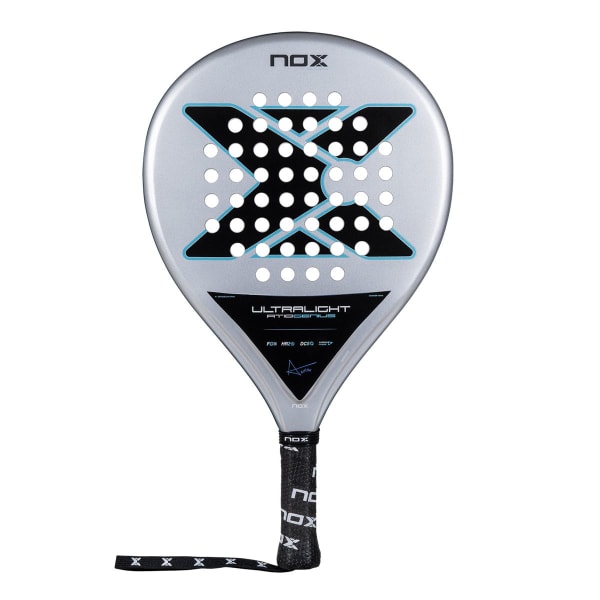
Nox AT10 Genius Ultralight 2025
✓Cross-checked with official data from Noxhow we score
PADELTESTLAB SCORE
0-100 scale
83/100
Price range
Description
Who this racket is for
Pros
- ✓The soft HR2 core paired with Silver Fiberglass 3K faces cushions the impact on volleys and bandejas, which the elbow appreciates during long rallies or when coming back from injury At 300-325g with a low balance, you can arrive late on the vibora and still close the swing in time; on cross-court defence the racket never lags behind the hand The round shape packs a wide sweet spot into the geometric centre: ball exit off the back wall doesn't die even if you strike half a centimetre off-axis The rough surface bites into the ball well on chiquitas and lifted lobs, helping the kick grip even though the racket doesn't generate pace on its own DCS technology reinforces the frame-face joint, a critical zone on an ultralight build where structural thickness runs thinner than usual
Cons
- ✗Punch is limited: on a flat smash you need to raise your arm well above the shoulder and aim for height, since the racket adds no extra depth, and a short bounce gets defended with ease The low weight costs you on a hard-hit counter or a blocking volley against a powerful smash; the head gets pushed back and the ball falls short to the centre of the court HR2's soft touch strips away feel on the dry volley: it's hard to sense exactly where the ball hits when you're chasing tight points near the back glass A player with a developed swing who already closes out smashes for winners will outgrow it within a few months and need to move up in weight and hardness
PADELTESTLAB SCORE
0-100 scale
83/100
It is at its lowest price since we started tracking it: €64.95, down from €84.34. We began recording on March 20.
Prices recorded daily since March 20 · 78 days of data
Agustín Tapia has a full range with NOX, and the AT10 Genius Ultralight 2025 sits at the lightest end: 300-325 grams, round shape, Silver Fiberglass 3K faces, a low-density HR2 core and a 38mm frame with DCS technology. This isn't a trimmed-down tour racket — it's built from the ground up for smaller hands and arms that can't yet handle a full-blown premium padel racket.
What level of player is the Nox AT10 Genius Ultralight built for?
It's designed for entry-level padel: junior players in the Ultralight/JR range, adults just starting out, and anyone coming back from tennis-elbow-type injuries. The 300-325g weight range, low balance and soft feel of the HR2 core cut down the load on the wrist and forearm rep after rep, which is exactly where the damage builds up.
| Spec | Value |
|---|---|
| Shape | Round |
| Weight | 300-325 g |
| Balance | Low |
| Face | Fibreglass — Silver Fiberglass 3K |
| Core | EVA Soft — HR2 |
| Frame | 38 mm |
| Surface | Rough |
| Technology | DCS (Dynamic Composite Structure) |
| Pro player | Agustín Tapia |
Silver Fiberglass 3K and HR2: why this racket forgives so much
Fibreglass flexes more than a carbon weave under the same impact. That flex does two things: it sends the ball back even when the strike isn't clean, and it filters out a good chunk of vibration before it ever reaches your grip.
The low-density HR2 core pulls in the same direction. It's a soft compound that gives on impact, extends dwell time on the face, and creates that momentary feeling of the ball "sticking" to the carbon face.
On court, that translates into a very generous ball exit paired with contained punch. In plain terms: the ball comes off easily and effortlessly, but it doesn't come off fast. Two different things that get mixed up all the time.
The DCS reinforcement works at the frame-face joint. On an ultralight build, that zone has less material to work with than on a standard-weight racket, and that's exactly where fatigue cracks tend to show up.
How it performs shot by shot
Ball exit off the back wall. This is where it shines brightest. The wide sweet spot of the round shape and the flex in the faces mean the ball doesn't die even when contact drifts off-centre. You can pull off a deep wall shot even with an underdeveloped swing.
Bandeja. Very comfortable. The 300-325g weight lets you carry the racket above shoulder height without your elbow dropping, and the rough surface bites into the ball with more grip than you'd expect from an entry-level racket.
Vibora. You can arrive late and still get the swing closed in time. What you won't get is pace: the vibora will be placed, not a winner.
Smash for the kill. The obvious weak point. With no mass behind the impact, you have to compensate with a higher arm and perfect timing, and a short bounce rarely clears the fence.
Volley. Soft and easy to direct on deep volleys down the middle, but short on feedback on the dry volley near the back glass. Against a hard-hit ball, the head gets pushed back and the ball falls short.
Is it a good pick if you're dealing with elbow pain?
This is exactly the profile it's aimed at. The mix of soft rubber, flexible fibreglass and minimal weight is the classic recipe for cutting down impact transmitted to the arm. It won't replace treatment, but it lets you keep playing hitting drills without piling on extra load.
One thing to watch for: such a light racket forces you to accelerate your arm more to generate the same ball speed. Anyone trying to hit hard with it ends up compensating with the wrist, and that's where the benefit disappears.
Player profile and ideal partner
- **Junior players** still growing, with the grip adapted for smaller hands.
- **Adults in their first few months** who prioritise consistency and placement over smashing.
- **Players in recovery** who need to get back on court with minimal load.
As part of a pair, it works best on the backhand side, alongside a partner who takes the high ball. Playing forehand in a pairing that relies on smashes to close out points, the lack of punch leaves the point open too often.
Verdict: a learning tool, not a racket to grow into forever
The Nox AT10 Genius Ultralight does exactly what it sets out to do: teach you to strike the ball with a racket that forgives, protects the arm, and responds just as well off-centre as it does dead in the middle. As the little sister of Agustín Tapia's Nox AT10 Genius, it shares the looks and the control philosophy, but not the performance.
The ceiling arrives fast for anyone improving quickly. Once a player starts closing out smashes consistently and hitting winning viboras, this padel racket runs out of road and it's time to move up in weight and rubber hardness. Bought with that expectation in mind, it's a solid choice; bought expecting punch, it'll disappoint in the very first set of high balls.
In the brand's lineup
Within Nox's lineup, the AT10 Genius Ultralight Agustín Tapia is one of the most accessible options starting at €67.95, perfect for getting started without a heavy outlay. Its overall score of 83/100 places it among the best control rackets we've reviewed.
Frequently asked questions
Who is the Nox AT10 Genius Ultralight 2025 for?
The Nox AT10 Genius Ultralight 2025 is built for beginner level: easy to handle and forgiving. Not the ideal pick if you already have consolidated technique.
How much does the Nox AT10 Genius Ultralight 2025 weigh?
The Nox AT10 Genius Ultralight 2025 weighs 300-325g according to the manufacturer's stated specs.
What's the Nox AT10 Genius Ultralight 2025's PadelTestLab score?
The Nox AT10 Genius Ultralight 2025 scores 83/100 in our review, based on power, hardness, control, maneuverability, ball exit, sweet spot and surface roughness.
How much does the Nox AT10 Genius Ultralight 2025 cost?
Current price of the Nox AT10 Genius Ultralight 2025 is 67.95€ – 79.95€, comparing 2 shops in our finder.
Similar alternatives
Other rackets with a similar profile and price range: