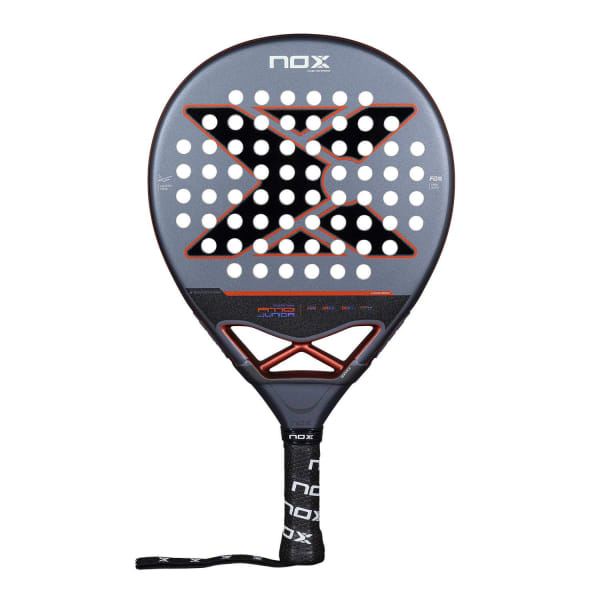
Nox AT10 Genius Junior By Agustín Tapia 2025
✓Cross-checked with official data from Noxhow we score
PADELTESTLAB SCORE
0-100 scale
79/100
Description
Who this racket is for
Pros
- ✓The soft HR3 White EVA core practically returns the ball on its own on defensive lobs and off-the-back-wall exits, exactly the shots where a junior's arm usually runs out of steam The FG3 fibreglass face cushions off-centre hits, so shots caught on the frame or near the throat still come back with usable direction Round shape with a wide, centred sweet spot, perfect for grooving volley and bandeja technique without punishing every millimetre of mistimed contact The 300-325g weight range keeps the racket manageable in fast net exchanges, where an adult-weight frame would arrive late on the second volley The Dynamic Composite Structure spreads the flex across the whole racket, avoiding the harsh, jarring response that loads up the wrist and elbow of a still-growing player
Cons
- ✗Raw power falls short on the smash: a junior who's already closing out points with a 3-wall smash will notice the ball loses depth and bounces short in court The soft EVA build tends to absorb rather than bite on the vibora, making it hard to generate that sharp sideways spin the shot demands Once a player outgrows the learning stage and starts chasing flat, fast pace, this racket hits its ceiling and it's time to move up to an adult model The shorter grip and reduced dimensions make it awkward for a beginner adult looking to borrow its forgiveness
PADELTESTLAB SCORE
0-100 scale
79/100
Out of stock right now
None of the shops we track has it in stock right now. We last saw it on August 1 at €80.66.
See similar rackets in stockNox AT10 Genius JR Review: Tapia's Racket, Sized for Learning
The Nox AT10 Genius JR by Agustín Tapia 2025 is a round-shaped padel racket weighing 300-325g, built with an FG3 fibreglass face, HR3 White EVA core and Dynamic Composite Structure technology. It's the junior translation of the Argentine star's Luxury Genius line: same matte finish, same colourway, just smaller dimensions and a shorter handle.
This isn't a small racket for marketing's sake. It's small because an eleven-year-old can't handle an adult-sized hitting surface without compensating through the shoulder.
Who is the AT10 Genius JR actually built for?
Young players still in the technical learning phase. Beginner level, all-round profile, with no bias toward power or extreme control.
The obvious sales pitch is Agustín Tapia's name. The real one is the combination of low weight and soft EVA: two choices that let a junior complete a full bandeja or volley swing without cutting it short from fatigue.
A beginner adult tempted by the forgiveness of this padel racket should look elsewhere. The short grip and compact face punish a bigger hand.
Spec sheet
| Spec | Value |
|---|---|
| Shape | Round |
| Weight | 300-325 g |
| Face | FG3 fibreglass |
| Core | Soft HR3 White EVA |
| Technology | Dynamic Composite Structure (DCS) |
| Level | Beginner |
| Play style | All-round |
| Player | Agustín Tapia |
FG3 over HR3 White: why this pairing is so forgiving
Fibreglass is a more flexible material than carbon and soaks up a good chunk of impact before passing it on to the arm. On court, that means off-centre contact doesn't vibrate or jolt the forearm, doesn't send that punishing feedback that makes a kid start swinging out of fear.
Underneath, the HR3 White EVA core is soft. It compresses on impact, holds the ball, and releases it. That's what powers the racket's ball exit on high balls: on a defensive lob from the back of the court, the racket does part of the work a junior's arm still can't.
The Dynamic Composite Structure works on the flex of the face-and-core combo. In practice, that means consistency: the response at the dead centre and the response three centimetres from the throat feel far more alike than they would on a racket with a rigid face.
Shot by shot
Volley. The standout. Round shape, light weight and a wide sweet spot let you block fast balls without arriving late for the second volley. This is the shot where the racket teaches best.
Ball exit off the back wall. The soft core gets the ball out even with a short backswing. A junior who just reaches the back wall can still send it back deep, keeping the point alive.
Bandeja. Easy to direct. The centred balance makes it simple to set the face and slice through the ball without the racket dropping. It won't generate an aggressive kick, but the goal here is grooving the technique, not winning the point outright.
Smash. The ceiling. Power is capped and the soft EVA cushions rather than snaps back. A flat smash comes out slower than expected, and a player who already closes points with a 3-wall smash will feel the ball bounce short in court.
Vibora. The other limit. That shot needs a face that bites and a short, sharp response; the soft combo here tends to absorb instead, making clean sideways spin hard to produce.
How long will a player actually use this racket?
Straight answer: as long as the goal is building technique and getting balls back in play, the AT10 Genius JR delivers. Once a junior starts closing points with the smash and chasing flat pace consistently, the racket runs out of headroom and it's time to move to an adult model with a firmer core.
That transition isn't a flaw in the product — it's exactly the cycle a learning racket is meant to cover.
What to know before buying
- **Buy for size, not for the name.** The Tapia connection is a legitimate draw, but the decision should come down to the player's height and strength. If the kid already handles adult weight comfortably, this racket will feel undersized.
- **The soft core is a joint-health call.** For growing players, cutting down transmitted vibration matters more than squeezing out a few extra km/h on the smash.
- **Accept the power ceiling.** This model isn't built to hit hard. It's built to teach placement.
Verdict
The Nox AT10 Genius JR nails the brief: a young player's padel racket that forgives mishits, gets the ball out on its own and goes easy on the arm, with the Argentine star's line aesthetic as the cherry on top.
The trade-off is power and bite on spin shots. That's a reasonable price to pay in a beginner racket — and a real issue only once the junior stops being a junior.
In the brand's lineup
Within Nox's lineup, the AT10 Genius JR positions itself as a distinctive alternative. With an overall score of 79/100, it's a solid choice within its price range.
Frequently asked questions
Who is the Nox AT10 Genius Junior By Agustín Tapia 2025 for?
The Nox AT10 Genius Junior By Agustín Tapia 2025 is built for beginner level: easy to handle and forgiving. Not the ideal pick if you already have consolidated technique.
How much does the Nox AT10 Genius Junior By Agustín Tapia 2025 weigh?
The Nox AT10 Genius Junior By Agustín Tapia 2025 weighs 300-325g according to the manufacturer's stated specs.
What's the Nox AT10 Genius Junior By Agustín Tapia 2025's PadelTestLab score?
The Nox AT10 Genius Junior By Agustín Tapia 2025 scores 79/100 in our review, based on power, hardness, control, maneuverability, ball exit, sweet spot and surface roughness.
Similar alternatives
Other rackets with a similar profile and price range: