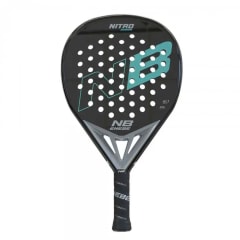
Nox At 10 Genius Ultralight 23
✓Cross-checked with official data from Noxhow we score

PADELTESTLAB SCORE
0-100 scale
79/100
Description
Who this racket is for
Pros
- ✓Weighing in from just 300 grams with a round shape, the face gets to the ball in time on quick cross-court volleys, letting you close the block even when you're a fraction late. The fiberglass face flexes on contact and the HR3 core soaks up the rest, so long defensive lobs and wall exits never punish the elbow or wrist. A huge sweet spot paired with a medium balance means off-center hits toward the frame's edge still land with direction, crucial when you haven't got smash timing down yet. On the bandeja the ball practically leaves the racket face on its own, no arm speed needed to send it cross-court and get back to net, something any junior player appreciates from match one. A slimmer grip and 38mm profile mean a kid's hand can fully close around the handle without piling on overgrips that throw off the racket's balance.
Cons
- ✗The flat smash from zone 3 comes up short: the HR3 core absorbs so much energy that you need real arm speed to make the ball kick low and skid out of the court. The smooth fiberglass surface doesn't bite much, so cut víboras and kick shots lose bite compared to a rough-textured face. On fast body shots the ultralight weight gives way: block firm or the face opens up and your return sails long. Players who already smash with confidence will hit this racket's ceiling within a few weeks; it's built for learning or for coming back from injury, not for climbing the competitive ladder.
PADELTESTLAB SCORE
0-100 scale
79/100
Out of stock right now
None of the shops we track has it in stock right now. We last saw it on August 1 at €89.00.
See similar rackets in stockNox AT10 Genius Ultralight 23: Agustín Tapia's mould, now at 300 grams
Nox didn't just shave weight when adapting the AT10 Genius for smaller hands. The Nox AT10 Genius Ultralight 23 sits in a 300-325g range, closes off the heart, slims the handle and mounts a fiberglass face over an HR3 EVA rubber core, with a 38mm profile and round shape. It's the lightest racket in the entire AT lineup.
That combination has direct consequences on court. A round shape with medium balance keeps mass close to the hand: the face reaches the ball sooner and the sweet spot widens toward the center of the hitting plane, exactly where a player still building their technique tends to make contact.
The closed heart supplies the other half of the equation. On such a lightweight racket, a rigid bridge stabilizes the response and prevents that loose-face feeling that shows up when blocking fast shots.
Who should actually be playing with the AT10 Genius Ultralight?
This racket is aimed at developing players, kids and juniors starting out in padel, plus adults who need a padel racket that won't strain the arm. The ultralight weight and HR3 core filter out much of the impact, which is also why it works as a comeback racket after elbow trouble or tennis elbow.
What it isn't: a racket for someone who already smashes with confidence. This model's control-oriented profile has a low ceiling, and you'll reach it fast.
As part of a pair, it fits best on the backhand side, where the job is defending, lifting lobs and holding the point. If the player is the one looking to finish points at net, the Ultralight will fall short sooner than expected.
Fiberglass and HR3: why the impact doesn't rattle your arm
Fiberglass flexes more than carbon on the same shot. It deforms on contact, holds the ball a fraction longer and gives back a soft touch instead of the sharp response of a rigid face.
That flex is what absorbs the vibration that travels up the wrist on fast body shots, and it explains why this Nox model shows up in the hands of players managing elbow issues.
The HR3 core follows the same logic: comfortable-feel EVA rubber, built to repeat the same response shot after shot rather than give energy back. On court, that means the ball exits easily even when your arm isn't putting in the work, but the racket won't hit for you.
The 38mm frame rounds out the package. It's a restrained profile that provides enough lateral stiffness to keep the face from twisting on a block, without adding the extra weight a thicker frame would bring.
Nox AT10 Genius Ultralight 23 specs
| Spec | Value |
|---|---|
| Shape | Round |
| Weight | 300-325 g |
| Balance | Medium |
| Face | Fiberglass |
| Core | HR3 EVA rubber |
| Frame | 38 mm |
| Surface | Smooth |
| Level | Beginner |
| Playstyle | Control |
| Pro reference | Agustín Tapia |
Shot by shot: where it delivers and where it falls short
Bandeja. The racket's best shot. The ball exits on its own, no arm speed required to send it cross-court and recover net position.
Volleys. Maneuverability is the star here. At 300 grams you can close the cross-court block even arriving late, and the round face forgives high contact without losing direction.
Wall exits and defense. The soft touch helps on long lobs: you guide the ball rather than strike it, sending it deep without straining the shoulder. On very fast balls, though, the light weight gives way and you need a firm block to keep the face from opening up.
Smash and víbora. This is the model's ceiling. The flat smash from zone 3 comes up short because the HR3 core absorbs too much energy, and the smooth surface generates little spin: cut víboras and kick shots lose bite compared to a textured face. This racket isn't built to finish points.
Three signs you've outgrown it
- You're smashing from the back and the ball keeps landing inside the court instead of skidding out.
- You go looking for spin on the víbora and the shot comes back flat.
- You feel the weight holding you back on contact instead of working with you.
Hit two of these three signs and it's time to move up in weight and level, the Ultralight has done its job.
Verdict on the AT10 Genius Ultralight
The Nox AT10 Genius Ultralight 23 delivers on its promise: minimal weight, a huge sweet spot and a touch that doesn't punish the joints. As a junior's first racket, or as a comeback racket for an adult nursing elbow trouble, it more than delivers.
As a racket to grow into, no. Anyone already smashing with confidence will feel the ultralight weight holding back their smash and the smooth surface's lack of grip.
It's a learning and comfort tool, carrying Agustín Tapia's name and the Nox AT10 Genius mould behind it, but with the trimmed-down performance that approach demands.
In the brand's lineup
Within nox's lineup, the at 10 genius ultralight positions itself as a distinctive alternative. With an overall score of 79/100, it's a solid choice within its price range.
Frequently asked questions
Who is the Nox At 10 Genius Ultralight 23 for?
The Nox At 10 Genius Ultralight 23 is built for beginner level: easy to handle and forgiving. Not the ideal pick if you already have consolidated technique.
How much does the Nox At 10 Genius Ultralight 23 weigh?
The Nox At 10 Genius Ultralight 23 weighs 300-325g according to the manufacturer's stated specs.
What's the Nox At 10 Genius Ultralight 23's PadelTestLab score?
The Nox At 10 Genius Ultralight 23 scores 79/100 in our review, based on power, hardness, control, maneuverability, ball exit, sweet spot and surface roughness.
Similar alternatives
Other rackets with a similar profile and price range: