Kombat Geo
✓Cross-checked with official data from Kombathow we score
PADELTESTLAB SCORE
0-100 scale
78/100
Description
Who this racket is for
Pros
- ✓The sandpaper-textured 18K carbon face bites into the ball on vibora and cut bandeja shots, holding that sidespin on newer balls longer than a smooth finish ever could The high-balance diamond shape stacks mass in the head and turns your smash by 3 into a momentum shot: you guide it through and the racket does the rest The medium Black EVA keeps a mid-range feel, so the ball comes off with some carry on deep volleys instead of dying flat against the rubber The 350-380g weight range lets you dial the racket to your arm: stay low in the range for sharper reaction at net, go high for raw pop on the flat smash
Cons
- ✗That high balance demands early preparation on the wall exit; come in with a dropped elbow and the racket arrives late, sending the ball straight into the net The diamond profile narrows the sweet spot: contact near the heart or the frame comes out shallow with a harsh, jarring vibration With a mid-feel medium EVA core, this isn't a racket that forgives a tired arm; in long matches the impact adds up if your smash technique isn't clean The rough sandpaper finish wears smooth with use, gradually losing the extra grip that makes it stand out on cut shots
PADELTESTLAB SCORE
0-100 scale
78/100
Out of stock right now
None of the shops we track has it in stock right now. We last saw it on August 10 at €39.95.
See similar rackets in stockKombat Geo Review: The 18K Diamond Racket With the G.E.O. Shield That Only Rewards Attackers
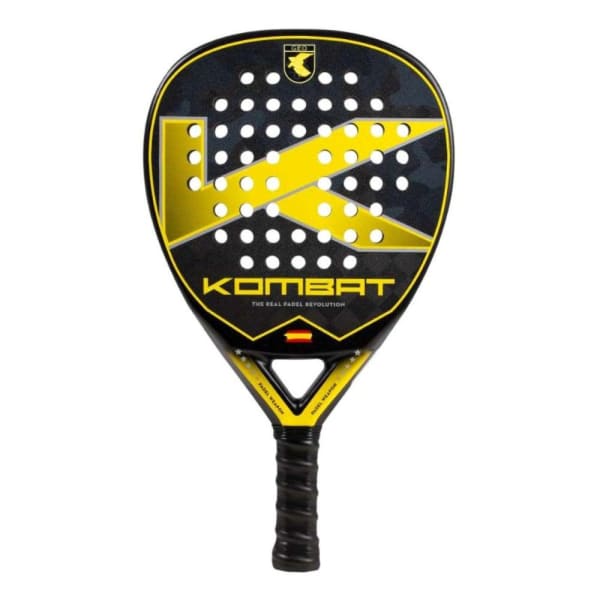
The Kombat Geo isn't a catalogue racket with a nice graphic slapped on. It's the G.E.O. edition — Grupo Especial de Operaciones — carrying the official shield screen-printed onto a sandpaper-finish 18K carbon face, built in a high-balance diamond shape around a medium-density Black EVA core. Weight sits between 350 and 380 grams. Every spec on that sheet points the same direction: hitting from above.
What sets the Kombat Geo apart from other power diamond rackets?
Two concrete things. First is the face finish: the 18K carbon isn't just lightly textured paint, it's genuinely sandpaper-rough. That translates into real bite on the ball during cut shots. Second is the rubber choice: Black EVA at medium density, not hard. A high-balance diamond paired with hard EVA would be a brutal, unplayable racket; here the brand softens the impact so the ball still gets some pop off the face.
The result is a padel racket that hits seriously hard without playing like a brick.
Kombat Geo specs at a glance
| Spec | Value |
|---|---|
| Shape | Diamond |
| Balance | High |
| Weight | 350-380 g |
| Face | 18K carbon |
| Core | Medium EVA (Black EVA) |
| Surface texture | Rough, sandpaper finish |
| Recommended level | Advanced |
| Playstyle | Power |
18K carbon and Black EVA: what each material brings to your game
An 18K carbon weave packs more filaments per tow than a 3K or 12K, giving a stiffer surface and a more immediate response. On court that means the ball exits fast, spending very little time on the string bed at contact — exactly what you want on a flat smash, where any delay in the racket's response costs you.
That stiffness comes at a price. An 18K face forgives off-center hits less than a softer weave, and on a diamond shape that flaw gets amplified because the sweet spot already sits high on the face.
The medium Black EVA is what balances the equation. A medium-density rubber absorbs part of the shock and delivers what the brand itself calls a balance between comfort and firmness. On a finishing volley you can feel the ball sink for a split second before leaving the face, giving you directional control a hard EVA core simply wouldn't.
How does the Kombat Geo play, shot by shot?
Smash by 3 and flat smash. This is the racket's whole sales pitch. The high balance piles mass into the head, and with a clean swing the racket generates its own acceleration. You don't need to muscle it — you guide the shot and let inertia do the work. This is the kind of racket that turns a decent smash into a winner.
Vibora and cut bandeja. The sandpaper finish is the real differentiator here. On newer balls the grip is obvious, the sidespin holds longer, and the ball opens up wide toward the back glass with extra travel. The bandeja comes off with solid depth as long as you get the racket ready in time.
Wall exits and defense. This is the weak point, and it's worth being upfront about it. The head-heavy weight punishes short, quick adjustments. If the ball skids off the glass and you arrive with a dropped elbow, the diamond shape won't turn in time and the ball dies mid-court. It demands early prep and disciplined footwork.
Volley. It performs better than the profile suggests, thanks to that medium core. Block volleys come off clean, and attacking volleys aimed at the opponent's feet carry real depth.
Who is this padel racket actually built for?
An advanced player who lives at the net, not one who plays defense well. The Kombat Geo asks for three things:
- **Solid smash technique** — without it, that narrow sweet spot will punish every off-center hit.
- **The physicality to swing head-heavy weight** — the high balance adds effort to every defensive shot.
- **The finisher's role in the pair** — it works best alongside a more control-oriented partner who can hold the point while you hunt the smash.
If you play the backhand side and your job is opening angles with vibora and closing out points by 3, this profile fits. If your game leans on sustaining rallies and clean wall exits, there are more well-rounded options out there.
Verdict: an honest attacking racket, not a racket for everyone
The Kombat Geo delivers exactly what its spec sheet promises: serious power from the air, noticeable grip on cut shots, and decent ball exit for what a diamond shape usually offers. The medium feel keeps it from being an uncomfortable racket to play with, and that's its smartest design call.
What it isn't: an all-round racket. Maneuverability is limited, the margin for error on off-center contact is thin, and your arm will feel it over long matches. On top of that, the rough finish smooths out with use, and some of that initial bite fades.
With a declared rating of 9 out of 10 for power and 8 for control, this Kombat model sits exactly where it claims to: on the attack. If that's what you're after and your level can back it up, it delivers.
In the brand's lineup
Within Kombat's lineup, the Geo positions itself as a distinctive alternative. With an overall score of 78/100, it's a solid choice within its price range.
Frequently asked questions
Who is the Kombat Geo for?
The Kombat Geo targets advanced players. It needs consolidated technique and is not recommended for beginners.
How much does the Kombat Geo weigh?
The Kombat Geo weighs 350-380g according to the manufacturer's stated specs.
What's the Kombat Geo's PadelTestLab score?
The Kombat Geo scores 78/100 in our review, based on power, hardness, control, maneuverability, ball exit, sweet spot and surface roughness.
Similar alternatives
Other rackets with a similar profile and price range: