Joma Challenge
✓Cross-checked with official data from Jomahow we score
PADELTESTLAB SCORE
0-100 scale
81/100
Description
Who this racket is for
Pros
- ✓That teardrop leverage with the head-heavy balance really shows up on the smash from position 3: the head drops on its own, and the 3K carbon face fires back a crisp, no-sink response. The rough face grips the ball on viboras and cut bandejas, producing a kick that skids low and awkward down the sideline. The EVA Pro core doesn't soften as the match drags on — ball exit speed in the third set matches what you get in the first. Despite its clear power bias, it holds enough control on the block volley to hang onto the net after a solid return. The rigid build is more forgiving than expected on slightly off-centre hits toward the throat, handy in fast net exchanges.
Cons
- ✗The head-heavy balance demands early prep: caught deep in defence off a wall exit, the racket feels heavy and your lob comes up short. The EVA Pro's density punishes a lazy swing — without arm speed, ball exit goes flat and you end up pushing shots from the back. The sweet spot on this teardrop shape runs narrower than on a round racket: hits near the tip, close to the 38mm frame, come out dead. At the top of the weight range, 370g starts to wear on delicate wrists in matches that run past ninety minutes.
PADELTESTLAB SCORE
0-100 scale
81/100
Out of stock right now
None of the shops we track has it in stock right now. We last saw it on August 2 at €142.94.
See similar rackets in stock38mm teardrop shape and EVA Pro: the Joma Challenge's recipe for power
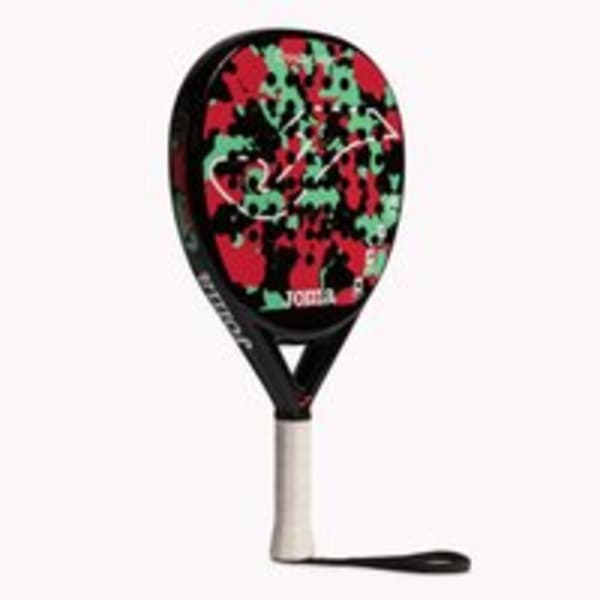
The Joma Challenge is a power-oriented teardrop padel racket, built with an interwoven 3K carbon face, EVA Pro core, 38mm frame, and a weight range of 350-370 grams. It's part of the padel line Joma rolled out in 2022, and it doesn't hide its intentions: a 60% power, 40% control split.
That 60/40 isn't just marketing talk. It shows up as a padel racket with weight pushed toward the head, dense foam, and a face with real texture — everything pulling in the same direction.
What does the interwoven 3K carbon face bring to this racket?
3K weave uses thicker threads than a 12K or 18K, which means a more textured surface and a less "flat" response off the strings. On the Joma Challenge, it pulls double duty.
First, stiffness: the interwoven 3K barely flexes on contact, so energy goes back into the ball instead of getting absorbed by the face. That's what gives you crisp, direct shots without that half-second of sink you get from softer rackets.
Second, grip. This face's roughness is the kind you can feel just running a finger over it, and with a fresh ball it really bites on the vibora and the cut smash.
The EVA Pro core rounds things out. It's a medium-to-high density foam that rewards a firm strike with real ball exit speed, and it holds that behaviour throughout a long session without going soft.
Tech specs
| Spec | Value |
|---|---|
| Shape | Teardrop |
| Weight | 350-370 g |
| Balance | Head-heavy |
| Face | Interwoven 3K carbon |
| Core | EVA Pro (medium EVA) |
| Frame | 38 mm |
| Surface | Rough |
| Playstyle | Power |
| Level | Intermediate |
Who is the Joma Challenge built for?
This racket suits an intermediate player with an aggressive game, someone who already has smash technique and isn't relying on the racket to "find" the ball for them. The head-heavy teardrop shape and dense foam reward fast arm speed and punish a soft or late hit. A beginner won't unlock the power and will just feel the weight up top.
The ideal profile is a player who crashes the net to finish points, not one waiting at the back for the opponent's mistake.
Shot by shot: where it shines and where it makes you pay
Smash. This is where the racket lives. The teardrop's leverage lets the head drop naturally into the ball, and the 38mm frame keeps things stable through a flat smash. The pinpoint smash from position 3 comes out with a tight, driving trajectory.
Bandeja and vibora. The rough face does the dirty work — the ball grips and skids low toward the sideline. The vibora is probably the model's second-best shot, as long as you attack the ball out in front of your body.
Volley. Firm and direct. The stiff construction gives very clear feedback, though on the defensive block volley you need to dial it in — it kicks off the strings more than a pure control racket would.
Wall exits and defence. This is its weak spot. With that head-heavy balance and up to 370 grams, maneuverability drops and you need to prep earlier. Get caught just short on a deep lob and it falls short, handing over the net.
Return of serve. Solid if you're blocking the return and moving forward. Less so if your game plan is a heavily worked topspin return from deep behind the baseline.
What's behind this Joma model's 60/40 split
That 40% control doesn't mean this plays like a control racket. It means the sweet spot is a touch more generous than you'd expect from a teardrop with this profile, especially through the centre-low part of the hitting surface.
Slightly off-centre hits toward the throat still hold their line. What it won't forgive is the tip — contact there comes out dead, with no depth.
Is the Joma Challenge worth it?
Three things to be clear on before deciding:
- **You need to commit to the shot.** The dense foam gives back exactly the energy you put in. With a slow arm, ball exit disappoints.
- **You'll give something up in defence.** The head-heavy balance is a deliberate trade-off: you gain smash power, you pay in maneuverability.
- **This is a net racket.** Its natural home is the forehand or backhand player who closes out points up top, paired with a partner who can hold the back court.
Coming from a balanced round racket, the difference hits you from the first warm-up: more weight up top, more bite on the smash, less margin for error. Coming from another power-oriented teardrop, this will feel familiar, and you'll appreciate the texture on the face.
The racket delivers on what it promises, with a coherent build: stiff face, firm core, 38mm frame, and an attack-oriented balance. It isn't trying to be an all-rounder — and that's exactly the point.
In the brand's lineup
Within joma's lineup, the challenge positions itself as a distinctive alternative. Its overall score of 81/100 places it among the best power rackets we've reviewed.
Frequently asked questions
Who is the Joma Challenge for?
The Joma Challenge fits the intermediate level. Suited to players with a technical base who want to progress without jumping to a competition racket.
How much does the Joma Challenge weigh?
The Joma Challenge weighs 350-370g according to the manufacturer's stated specs.
What's the Joma Challenge's PadelTestLab score?
The Joma Challenge scores 81/100 in our review, based on power, hardness, control, maneuverability, ball exit, sweet spot and surface roughness.
Similar alternatives
Other rackets with a similar profile and price range: