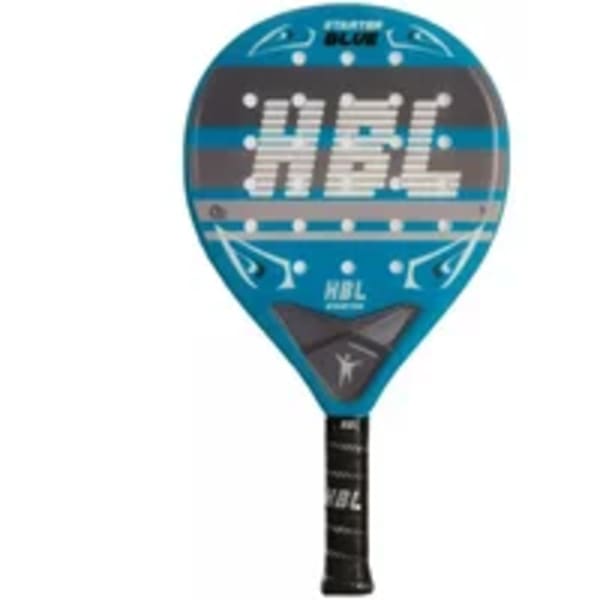
Hbl Starter
✓Cross-checked with official data from Hblhow we score
PADELTESTLAB SCORE
0-100 scale
80/100
Price range
Description
Who this racket is for
Pros
- ✓The round shape and low balance concentrate the sweet spot in the centre of the face, so off-centre volleys still come out with direction instead of dying in the net
Cons
- ✗That easy ball exit from the foam core costs you on the smash: no matter how high you reach, the ball won't come down with any weight, giving your opponent time to cover the rebound
PADELTESTLAB SCORE
0-100 scale
80/100
It is down 20% from its highest price: from €43.99 to €35.00. Tracked since April 16.
Prices recorded daily since April 16 · 43 days of data
HBL Starter Review: The Beginner Padel Racket Built to Take a Beating
The HBL Starter has one clear job: survive the first few months of a player who still doesn't know where the back wall is. One-piece polycarbonate and thermoplastic construction, round shape, low balance, a 38 mm profile and a weight of 335 to 350 grams. No carbon, no technical fabrics, no pro's name stamped on the frame. This is a beginner padel racket that owns exactly what it is.
In the entry-level segment, that's no small thing. Most first-racket disappointments have nothing to do with lack of power — they come from a racket that starts delaminating after the third scrape on the ground, or one that punishes your elbow every time the ball catches you off the sweet spot.
What Does "One-Piece Construction" Actually Mean at This Price Point?
On a conventional racket, the face, frame and core are separate pieces bonded together with adhesive. That bond is exactly where delamination starts: the face pulls away from the core, the racket starts sounding hollow, and it loses feel months before it actually breaks.
The HBL Starter's one-piece construction removes that weak point. Polycarbonate and thermoplastic form a single continuous body, making it far more forgiving of the accidental knocks that come with learning: scraping the mesh, dropping the racket, clashing paddles with your partner on a crossed volley.
The trade-off shows up in feel. A thermoplastic body transmits a duller, more plasticky sensation than a well-laminated carbon face. Ball exit is there, but you won't get that crisp, lively pop you'd expect after a couple of seasons on court.
How It Plays, Shot by Shot
Defence and getting the ball off the back wall. This is where the racket's approach pays off. The low balance keeps the mass close to your hand, so the racket whips through fast and you get to deep lobs in time. On mid-to-high wall exits, the wide sweet spot of the round shape forgives off-centre contact and the ball still crosses the net.
On very low wall exits — the knee-to-the-floor kind — the 38 mm profile starts to bite: less effective surface under the ball and less margin if you're stretching.
Volley. This is where it performs best. At 335 grams the racket sets up in front of your body with minimal effort, and the Puente cerrado (closed bridge) filters out a good chunk of impact vibration. Block volleys hold their direction even when contact drifts toward the throat of the racket.
Bandeja. Middling. A low balance leaves the head short on inertia, and the bandeja needs exactly that: weight to drive the ball deep into the back wall. It comes out controlled but short. You'll need to extend your follow-through and accept you're not going to pin your opponent to the glass.
Smash and vibora. This is the model's ceiling. The foam core absorbs energy rather than returning it, so a flat smash lands with less pace than you put into it. And the smooth surface doesn't bite the ball: the vibora comes out without real sidespin, closer to a soft cut shot than a true vibora.
HBL Starter Specs
| Spec | Value |
|---|---|
| Shape | Round |
| Weight | 335-350 g |
| Balance | Low |
| Face | Fibreglass (one-piece polycarbonate and thermoplastic) |
| Core | Foam |
| Profile | 38 mm |
| Surface | Smooth |
| Technology | Puente cerrado (closed bridge) |
| Playstyle | Control |
| Level | Beginner |
Who Should Actually Buy This Racket?
Straight answer: anyone with less than a season on court, training once or twice a week, who's still missing more balls from mishits than from lack of power. The round shape, low balance and wide sweet spot cover for technical errors, while the one-piece body shrugs off the knocks that come with learning. This isn't a racket for someone already closing out points on the smash.
If your problem on court is that the ball won't cross the net from the back, this HBL model will help. If your problem is that you're smashing and your opponent keeps sending it back, it won't.
What You Gain, and What You Give Up
The Starter is a consistent piece of design: everything it gives you in maneuverability, forgiveness and durability, it takes back in power and spin. That's a deliberate trade-off, not a design flaw.
Two limits worth knowing before you buy:
- **You'll outgrow it fast.** The moment you start smashing with real weight transfer, the foam core and low balance will hold you back. Expect a season, maybe two.
- **It won't teach you spin.** With a smooth surface, you won't feel the difference between a cut ball and a flat one — and that's a lesson worth starting early.
The model comes in two colourways — Blue Light and Red Light — with the same 335-350 g weight range and the same thermoplastic build. The choice between them is aesthetic, not technical.
Verdict
The HBL Starter does exactly what it sets out to do: get you through the early months without falling apart or hammering your arm. Its value lies in the one-piece construction and Puente cerrado (closed bridge), not in shot performance, which clearly falls short of what an intermediate player needs.
Buy it if you're just starting out and want a padel racket tough enough to survive the learning curve. Skip it if you already know exactly where you want your bandeja to land.
In the brand's lineup
Within hbl's lineup, the starter is one of the most accessible options starting at €35, perfect for getting started without a heavy outlay. Its overall score of 80/100 places it among the best control rackets we've reviewed.
Frequently asked questions
Who is the Hbl Starter for?
The Hbl Starter is built for beginner level: easy to handle and forgiving. Not the ideal pick if you already have consolidated technique.
How much does the Hbl Starter weigh?
The Hbl Starter weighs 335-350g according to the manufacturer's stated specs.
What's the Hbl Starter's PadelTestLab score?
The Hbl Starter scores 80/100 in our review, based on power, hardness, control, maneuverability, ball exit, sweet spot and surface roughness.
How much does the Hbl Starter cost?
Current price of the Hbl Starter is 35€, comparing 1 shop in our finder.
Similar alternatives
Other rackets with a similar profile and price range: