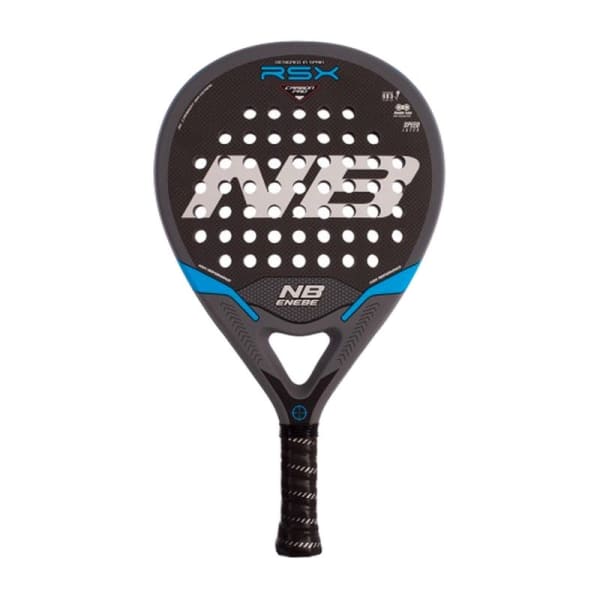
Enebe RSX Azul
✓Cross-checked with official data from Enebehow we score
PADELTESTLAB SCORE
0-100 scale
80/100
Price range
Description
Who this racket is for
Pros
- ✓The Ultrasoft EVA core soaks up the shock on fast blocked volleys and quick counters — the ball doesn't fly off uncontrolled from your opponent's strings, and your arm still feels fresh in the third set The 3K carbon face flexes just enough to forgive off-centre contact, which you'll appreciate on rushed wall exits and mistimed mid-height defensive shots The rough matte surface really grips the ball on cut bandejas and viboras, producing a steeper drop than you'd expect from a medium-balance teardrop racket The medium balance keeps the head under control, letting you switch from bandeja to vibora without re-adjusting your grip or losing prep time Genuine two-wing versatility — you're not forced to specialise on one side of the court to get the best out of it
Cons
- ✗The Ultrasoft rubber demands your own arm speed: swing with a short, lazy stroke and the smash falls short, letting your opponent send it back comfortably from the baseline The sweet spot sits above the geometric centre of the teardrop, so low hits near the throat come out muffled with little ball exit The rough texture loses bite on courts with heavy sand infill, and with it goes some of the cut/spin effect that's this racket's strongest selling point An advanced player who lives off a flat smash will hit the power ceiling sooner than they'd like — this racket gets the job done, it doesn't blow opponents away
PADELTESTLAB SCORE
0-100 scale
80/100
It is at its lowest price since we started tracking it: €129.95, down from €139.95. We began recording on March 20.
Prices recorded daily since March 20 · 78 days of data
Teardrop shape, 3K carbon face, Ultrasoft EVA core. The Enebe RSX Azul builds on three technical choices that all pull in the same direction: a soft rubber compound, an open-weave carbon fabric, and a rough matte finish over a medium balance. On court, the result is an all-court padel racket where control sits half a step ahead of power.
3K carbon over soft rubber: what each layer actually does
3K carbon is a more open weave than the high-thread braids you see on stiffer rackets. Translated into feel: the face flexes a touch more on contact, the sound off the strings is duller, and off-centre hits punish your wrist less.
Underneath, the Ultrasoft EVA core stretches out contact time. The ball stays glued to the face a fraction longer before leaving it, and that extra dwell time is exactly what lets you steer the shot instead of just returning it.
The trade-off is predictable, and it's worth saying plainly: a soft EVA core eats up some of the energy you put into the shot. Ball exit on the Enebe RSX Azul is solid and progressive rather than explosive. Coming from a hard-core racket, you'll notice you need to push harder to get the same pace on the ball.
Specs at a glance
| Spec | Value |
|---|---|
| Shape | Teardrop |
| Balance | Medium |
| Face | 3K Carbon |
| Core | EVA Soft (Ultrasoft EVA) |
| Surface | Rough, matte finish |
| Level | Intermediate |
| Playstyle | All-court |
Who is the Enebe RSX Azul actually for?
It's built for players moving from advanced-beginner into intermediate territory — players who already place the ball and want a padel racket that holds up on both attack and defence. The teardrop shape with medium balance and soft core gives forgiveness on off-centre hits without sacrificing a decent smash. It's not a finishing tool for advanced-level players.
Three player types it suits well:
- Someone stepping up from a round racket who wants extra pop without losing maneuverability at net.
- Anyone nursing elbow or wrist niggles who needs contact that isn't harsh.
- The intermediate who plays both sides depending on partner and can't justify owning a side-specific racket.
Shot by shot: where it shines and where it falls short
Wall exit. The medium balance stops the head dropping when your prep runs late. You can hang back on the glass and pull the ball out with a short, compact motion — it doesn't demand the anticipation a head-heavy racket requires.
Bandeja. Its best shot by far. The soft touch lets you guide the ball through the cut rather than hit it, and the rough face does the rest, making it die quickly after the bounce.
Vibora. The teardrop shape concentrates mass slightly above centre, and that's where this racket shows real judgement. It comes off with plenty of revs when you attack the ball from outside, but you need to make contact high — below shoulder height it loses bite.
Smash. There's power on tap, but the racket won't hand it to you for free. With a fast arm and good timing the smash goes deep with enough kick to clear the back fence; a lazy swing leaves it sitting up in mid-court.
Volley and block. This is where the soft EVA core earns its keep on its own. Blocks against fast pace come back controlled, without that uncontrolled kick you get off harder cores, and cut volleys stop dead near the net.
Deep defence. The lob comes out precise because the racket doesn't over-rebound the ball. It's a reliable shot for taking back the net.
Does the rough matte surface actually generate spin?
Yes, and it's one of this racket's strongest arguments. The pronounced texture combined with the soft rubber's longer contact time multiplies the grip on the ball — most noticeable on cut bandejas and sliced drop shots, where the ball stays low off the bounce and dies.
The honest caveat: no rough texture lasts forever. On courts with a lot of sand infill, the face polishes down over the weeks and the effect gradually softens. It's a consumable, not a permanent trait.
Verdict: friendly control with a power ceiling
This Enebe model works as a well-judged transition racket. It builds confidence for intermediates because it forgives, cushions, and performs evenly on both wings, and its combination of 3K carbon with Ultrasoft EVA delivers a comfortable feel that's not common in a teardrop shape.
What you won't find is the raw power of a stiff, head-heavy racket. Anyone looking to close out points with a flat smash from mid-court will find the Enebe RSX Azul asks for one extra bit of effort to finish the job.
As a doubles partner, it wants someone on the other side willing to take on the finishing shots: this racket holds up the point, feeds you reliable bandejas and gets you back to net, but the final ball is one you'll have to force yourself.
In the brand's lineup
Within Enebe's lineup, the RSX Azul occupies the mid-range starting at €110.95, offering highly competitive value for its segment. Its overall score of 80/100 places it among the best all-round rackets we've reviewed.
Frequently asked questions
Who is the Enebe RSX Azul for?
The Enebe RSX Azul fits the intermediate level. Suited to players with a technical base who want to progress without jumping to a competition racket.
What's the Enebe RSX Azul's PadelTestLab score?
The Enebe RSX Azul scores 80/100 in our review, based on power, hardness, control, maneuverability, ball exit, sweet spot and surface roughness.
How much does the Enebe RSX Azul cost?
Current price of the Enebe RSX Azul is 110.95€ – 129.95€, comparing 2 shops in our finder.
Similar alternatives
Other rackets with a similar profile and price range: