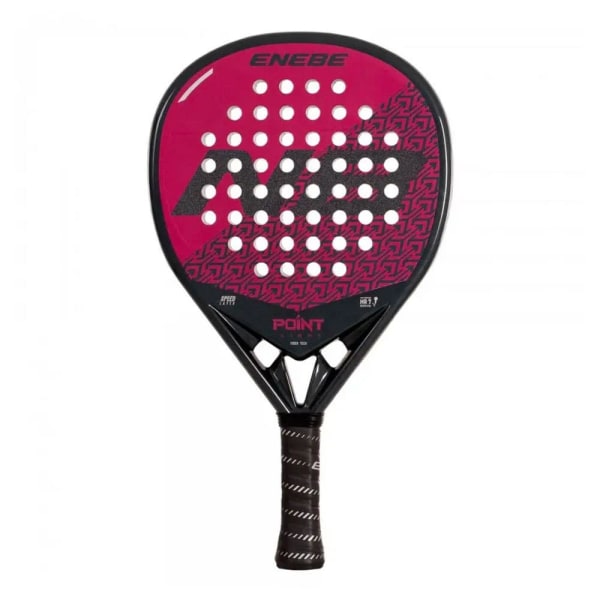
Enebe Point Light
✓Cross-checked with official data from Enebehow we score
PADELTESTLAB SCORE
0-100 scale
76/100
Price range
Description
Who this racket is for
Pros
- ✓The Soft EVA core cushions blocks and defensive volleys, cutting the vibration that punishes your wrist and elbow before your timing is dialled in The fibreglass face flexes on contact and does the work for you: scrambling off the back wall or hitting a rushed emergency lob, you get depth without having to accelerate your arm The teardrop shape's wide sweet spot forgives off-centre hits toward the top of the face, which is exactly where mis-timed bandejas tend to land in your first few months on court Its maneuverability lets you correct late at the net, reaching crossed reflex volleys before the racket gets ahead of your hand
Cons
- ✗The smooth surface barely grips the ball: sliced bandejas and viboras with sidespin come out far flatter than you'd want Soft EVA compresses under load on a flat smash; when you want to close out the point on a 3-ball, it comes back with less pace than you put into it The fibreglass face loses feel and softens up sooner than stiffer constructions, so with regular play its lively response doesn't last long The soft, elastic package hits a ceiling fast: as soon as your arm speed picks up, it'll fall short both on power and on control of a fast ball
PADELTESTLAB SCORE
0-100 scale
76/100
It is at its lowest price since we started tracking it: €67.99, down from €80.95. We began recording on March 20.
Prices recorded daily since March 20 · 140 days of data
Few beginner padel rackets show their hand as quickly as the Enebe Point Light: fibreglass face, Soft EVA core, teardrop shape, smooth surface. Four choices all pulling in the same direction — effortless ball exit, no punishment for the arm.
This isn't a signature racket and it doesn't pretend to be. It's first-months-on-court gear, and it should be judged as such.
Fibreglass over Soft EVA: what it feels like on contact
Fibreglass is an elastic face: it deforms more than a stiffer weave and gives that deformation back as ball exit. Swing with modest arm speed and the ball still comes out with depth. On this padel racket, that's the dominant trait, ahead of both power and control.
The Soft EVA core pushes the same idea from within. A softer rubber compresses more and rebounds more slowly, which stretches out contact time and softens the impact spike. On court that means a plush, muted strike — none of the sharp crack of a firmer core — and less vibration reaching your wrist and elbow. That joint-friendly feel is an explicit part of the model's design brief, not a side effect.
The teardrop shape sits halfway between round and diamond: it carries a touch more mass above the geometric centre than a round frame, without demanding the surgical timing a diamond shape calls for. That's where its all-round character comes from — it's built to neither attack nor defend exclusively.
Who is the Enebe Point Light actually for?
It's built for beginners — players with under a season on court, or who play only occasionally. The mix of fibreglass face, Soft EVA core and generous sweet spot puts comfort and ease of striking ahead of competitive performance, with an all-round profile that doesn't force you to choose between attacking and defending.
An intermediate-to-advanced player will hit the ceiling within the first hour on court. That's not a manufacturing flaw — it's simply who this racket is aimed at.
Shot by shot: where it delivers and where it doesn't
- **Wall exits:** its best terrain. The face flexes and sends the ball deep even when you're rushed for space and can't follow through properly.
- **Lob:** very easy to get up. Minimal arm swing is enough to reach the back of the court, which matters while you're still building technique.
- **Volley:** manageable and stable. You reach crossed reflex volleys without the racket running ahead of your hand.
- **Bandeja:** the wide sweet spot forgives high, off-centre contact — common while you're still judging the lob. But the smooth finish barely bites the ball, so the slice comes out flatter than you're after.
- **Vibora:** same problem, worse. Without surface texture there's no real sidespin, and without spin the vibora stops being an attacking shot.
- **Flat smash:** the soft rubber compresses under load. You close points with placement, not pace; the smash for a 3-ball lands, but without the extra gear a real hitter needs.
Tech specs
| Spec | Value |
|---|---|
| Shape | Teardrop |
| Face | Fibreglass |
| Core | Soft EVA |
| Surface | Smooth |
| Playstyle | All-round |
| Recommended level | Beginner |
How long will the Point Light actually last you?
Every beginner racket has a sell-by date, and this one's written right into the materials. Two clear signs you've outgrown it:
- You start smashing for pace and the ball simply won't go faster, no matter how much you accelerate your arm.
- You want to slice bandejas and add spin to viboras, and the smooth surface gives you nothing back.
Add physical wear to that: a fibreglass face loses its feel sooner than stiffer builds. With three or four sessions a week, its window of lively response is shorter than the price tag might suggest.
Verdict: comfort first, performance second
The Enebe Point Light does one thing well, and does it consistently: it gets the ball out with minimal effort and without punishing your joints. Generous sweet spot, comfortable handling, soft strike. For someone just landing in padel, or coming back from elbow trouble, that package is worth more than any theoretical gain in power.
What you shouldn't expect is range. The smooth surface shuts down spin-based play, and the soft build puts a low ceiling on your smash. In a price band running roughly €75 to €95, the useful question isn't whether it's the best racket on the market — it's how many months you'll need it before you go looking for something with more bite.
If your goal is grinding out long rallies, defending well and walking off court without elbow pain, it delivers. If you're already slicing your bandeja or thinking of the vibora as a weapon, start looking elsewhere.
In the brand's lineup
Within Enebe's lineup, the Point Light is one of the most accessible options starting at €64.95, perfect for getting started without a heavy outlay. With an overall score of 76/100, it's a solid choice within its price range.
Frequently asked questions
Who is the Enebe Point Light for?
The Enebe Point Light is built for beginner level: easy to handle and forgiving. Not the ideal pick if you already have consolidated technique.
What's the Enebe Point Light's PadelTestLab score?
The Enebe Point Light scores 76/100 in our review, based on power, hardness, control, maneuverability, ball exit, sweet spot and surface roughness.
How much does the Enebe Point Light cost?
Current price of the Enebe Point Light is 64.95€ – 100€, comparing 4 shops in our finder.
Similar alternatives
Other rackets with a similar profile and price range: