Dunlop Tristorm Lite
✓Cross-checked with official data from Dunlophow we score
PADELTESTLAB SCORE
0-100 scale
77/100
Price range
Description
Who this racket is for
Pros
- ✓Ball exit is about as generous as you'll find in a diamond-shaped racket: the EVA Soft core compresses on impact and still sends the ball deep even when you're caught flat-footed with no leg drive At 340-360g you can get to a high ball without the long lead-up a heavier diamond demands, which bails you out on shaky bandejas late in a third set The Power Frame keeps torsion in check on high, off-center contact — the smash comes out straighter than you'd expect from a lightweight racket in this shape The sandy surface bites into the ball nicely on the vibora and the cut bandeja, with enough kick to jam your opponent after the bounce The EVA Soft core noticeably filters vibration, a genuine selling point if you're carrying elbow trouble but don't want to give up the diamond shape
Cons
- ✗Fine touch is the weak link: a blocked volley with a still racket tends to sail long because the soft rubber gives back more energy than you asked for The high balance still costs you on defense: on a low, rushed wall exit you feel the head-heavy weight and struggle to close the face in time Drop the weight and a diamond loses impact inertia — if you already swing hard, you'll miss the mass the Tristorm Pro line brings The sweet spot stays high and narrow; shots near the throat come out muted with no real direction
PADELTESTLAB SCORE
0-100 scale
77/100
It is at its lowest price since we started tracking it: €76.95, down from €110.51. We began recording on April 30.
Prices recorded daily since April 30 · 51 days of data
Dunlop Tristorm Lite 2025 Review: The Diamond Racket That Won't Punish Your Arm
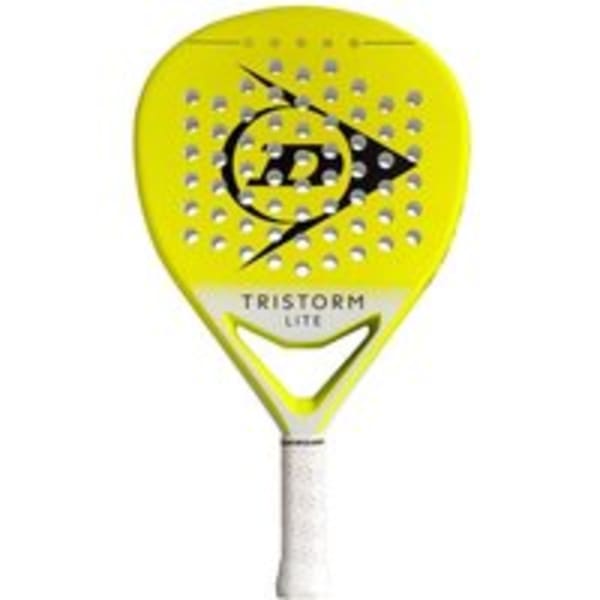
The Dunlop Tristorm Lite 2025 is a high-balance diamond-shaped padel racket that holds at 340-360 grams (350g nominal), built with a carbon and fiberglass face, an EVA Soft core and a Power Frame chassis. Dunlop sums it up in three words — *power mastered by lightness* — and for once the tagline actually matches what happens on court.
Diamond shapes concentrate mass in the head and push the sweet spot up toward the top of the face. Normally that comes bundled with weight that wears down your shoulder by the third set. Not here.
This padel racket is built for players developing an attacking game who don't yet have the technique or the muscle to control a heavier, top-tier diamond.
Who Should Play With the Dunlop Tristorm Lite?
Intermediate players with attacking ambitions. This is an assisted-power racket: the diamond shape and high balance put the mass where it counts, and the lighter weight lets you reach a high ball without the extended prep a heavier diamond forces on you. It's not a racket for anyone chasing pinpoint placement.
Power Frame, V Holes and EVA Soft: Breaking Down the Tech
Power Frame stiffens the rim and limits flex on contact. On high, off-center hits — the classic smash-from-the-third scenario — the face twists less and the ball flies straighter than you'd expect from a lightweight racket.
V Holes perforate the upper section of the frame. Removing material up top on a racket that's already head-heavy is what keeps the head loaded without slowing down the swing when you transition from defense to attack.
EVA Soft is the heart of the whole concept. The foam compresses on impact, sends the ball back with minimal arm effort, and soaks up a good chunk of vibration. Dunlop leans hard into that joint-protection angle, and it tracks with what you actually feel off-center: muted, never harsh or jarring.
The carbon-and-fiberglass face rounds out the picture. Fiberglass adds flex and feel where pure carbon would add stiffness; the net result is a face that forgives rather than corrects.
Extra Grip on the handle and a sandy face surface finish the package: secure grip even with sweaty hands, plus enough bite to generate spin.
Dunlop Tristorm Lite Specs
| Spec | Value |
|---|---|
| Shape | Diamond |
| Weight | 340-360g |
| Balance | High |
| Face | Carbon and fiberglass |
| Core | EVA Soft |
| Surface | Sandy |
| Technologies | Power Frame, V Holes, Extra Grip |
| Level | Intermediate |
| Playstyle | Power |
From the Smash to the Wall Exit: How It Plays Shot by Shot
Smash and flat overhead. This is where the shape earns its keep. The high balance drives the face down through the final phase of the swing and the Power Frame keeps it stable. The ball comes out deep, though raw power falls short of a heavier diamond — here the pace comes from swing speed the light weight allows, not from mass.
Bandeja and vibora. The sandy surface grips well and lets you cut the ball with confidence. On the vibora the kick is real: the ball bounces and skids wide enough to trouble opponents camped at the net.
Volleys. Its Achilles' heel. The EVA Soft core gives back more energy than you asked for on a blocked volley with a still racket, and without a conscious wrist adjustment the ball sails long. You'll need to lean on cut and guided volleys instead.
Defense and wall exits. The light weight helps you maneuver, but the high balance is still there: on a low, rushed ball off the back glass you feel the head and struggle to close the face in time. Defensive lobs demand early setup.
Off the sweet spot. The sweet spot sits high and isn't especially wide. Shots near the throat come out muted with no real direction — but they don't sting either, which is exactly the trade-off this racket is built around.
Tristorm Lite or Dunlop Tristorm Pro?
The Lite is the lightweight take on the Tristorm concept. If you're coming from a control racket and want to explore the diamond shape without sacrificing maneuverability, this is the entry point. If you're already smashing with confidence and want more mass behind the impact, the Dunlop Tristorm Pro is the natural step up.
Verdict: Who Should Buy the Dunlop Tristorm Lite
Three player types fit the bill:
- Intermediates looking to shift from defending to attacking who need a racket that rewards the attempt instead of punishing the miss.
- Players with a history of elbow issues who aren't ready to give up on the diamond shape.
- Anyone putting in heavy weekly hours who'd rather finish the match feeling fresh than chase maximum power.
Skip it if your game is built on precision — control is what's been traded away for that generous ball exit. And don't expect the punch of a heavier diamond: the Tristorm Lite swaps impact mass for swing speed, and you'll feel that difference when a point comes down to a full-blooded smash.
In the brand's lineup
Within dunlop's lineup, the tristorm lite is one of the most accessible options starting at €54.95, perfect for getting started without a heavy outlay. With an overall score of 77/100, it's a solid choice within its price range.
Frequently asked questions
Who is the Dunlop Tristorm Lite for?
The Dunlop Tristorm Lite fits the intermediate level. Suited to players with a technical base who want to progress without jumping to a competition racket.
How much does the Dunlop Tristorm Lite weigh?
The Dunlop Tristorm Lite weighs 340-360g according to the manufacturer's stated specs.
What's the Dunlop Tristorm Lite's PadelTestLab score?
The Dunlop Tristorm Lite scores 77/100 in our review, based on power, hardness, control, maneuverability, ball exit, sweet spot and surface roughness.
How much does the Dunlop Tristorm Lite cost?
Current price of the Dunlop Tristorm Lite is 54.95€ – 108.2€, comparing 3 shops in our finder.
Similar alternatives
Other rackets with a similar profile and price range: