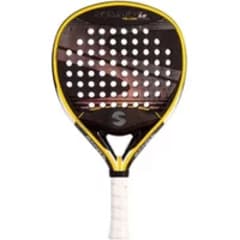
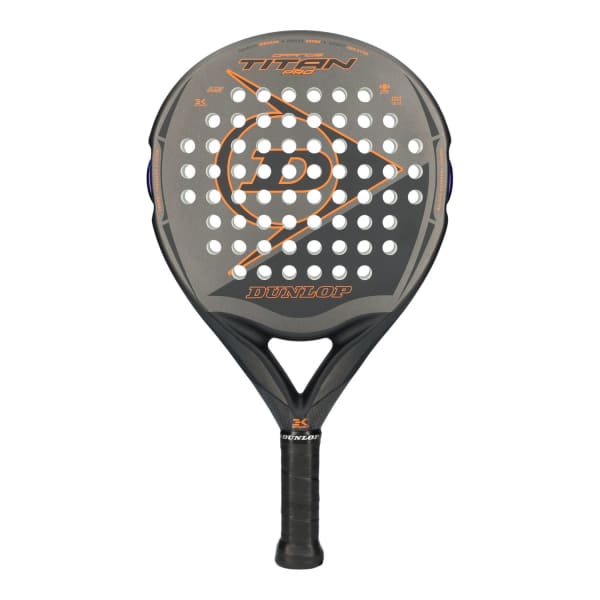
Dunlop Titan Pro Orange 2024
✓Cross-checked with official data from Dunlophow we score
PADELTESTLAB SCORE
0-100 scale
77/100
Price range
Description
Who this racket is for
Pros
- ✓The Power Bar, a high-density gel tube running through the frame, shifts toward the head as you load up a smash and delivers a very generous ball exit without needing a long swing The double-layer high-flex fiberglass face sinks the ball into the stringbed and forgives off-center contact: cut bandejas come out deep even when timed late The oversize shape and medium balance stretch the sweet spot upward, giving you margin on low wall exits and rushed defensive volleys The carbon insert in the bridge provides a rigid anchor that stabilizes the frame on the vibora, where fiberglass alone would tend to twist A fixed 370g with no weight range removes the lottery of picking a unit: the racket you test is exactly the one you buy
Cons
- ✗The single 370g weight punishes fast volley-to-volley exchanges; there's no lighter version to drop down to if your wrist starts to feel it The fiberglass face doesn't give you carbon's crisp, dry response: on a flat smash chasing glass, it lacks the immediate punch that rigid faces deliver The smooth surface limits bite on the pinchada and kick serve; you have to compensate with arm speed because the racket won't grip the ball on its own The Energy Transfer System needs a clean, well-defined swing to relocate the gel: on improvised or half-committed shots, the behaviour is less predictable
PADELTESTLAB SCORE
0-100 scale
77/100
It is at its lowest price since we started tracking it: €74.95, down from €79.95. We began recording on March 20.
Prices recorded daily since March 20 · 78 days of data
Dunlop Titan Pro Orange 2024: the padel racket that shifts weight mid-swing
The Dunlop Titan Pro Orange 2024 is a 370g oversize racket with a double-layer high-flex fiberglass face, a wave-textured graphite frame with a 100% carbon insert in the bridge, and a genuinely unusual technology: the Power Bar, a tube filled with high-density gel that physically moves inside the frame depending on the shot you're hitting.
That's not marketing fluff in translation. It's the actual reason this padel racket behaves differently from any conventional oversize model.
What does the Power Bar on the Titan Pro Orange 2024 actually do?
The Power Bar is a tube of high-density gel embedded in the frame. The system that controls it, the Energy Transfer System, lets that gel shift toward the head or the bridge depending on the motion you make.
In practice: when you load up a smash and accelerate, the mass migrates toward the head and the effective balance climbs in that specific instant. When you block a volley or cut a bandeja, the gel drifts back toward the bridge and the racket turns more maneuverable.
At rest it's a medium-balance racket, but it behaves like two different rackets depending on what you ask of it. There's no magic involved: the effect is subtle and depends on the swing being wide and clean enough to generate the inertia that actually moves the gel.
Spec sheet
| Spec | Value |
|---|---|
| Level | Advanced |
| Playstyle | All-round |
| Weight | 370g |
| Balance | Medium |
| Face | Fiberglass (double-layer, high-flex) |
| Core | EVA Medium — Mega Flex Core |
| Surface | Smooth |
| Technologies | Power Bar, Energy Transfer System |
Fiberglass and Mega Flex Core: elasticity over hardness
Pairing a double-layer fiberglass face with an EVA Medium core dubbed the Mega Flex Core defines the feel of this Dunlop release: the ball sinks into the stringbed on contact, sits there a fraction longer, and comes off with a clear, progressive trajectory.
That sink is what produces the highest ball exit on the whole spec sheet. On a defensive lob from the back of the court you don't need to push through the shot — just guide it and the racket sends the ball deep into the opponent's court.
The trade-off is an honest one. A fiberglass face is never going to give you the crisp, dry response of a rigid carbon face. On a flat smash chasing glass you'll notice the ball takes a beat longer to leave the stringbed, and that beat is feedback some players miss.
That's where the second structural piece comes in: the 100% carbon insert in the bridge. That rigid anchor stops the frame twisting on off-center hits, which is exactly the weak point of flexible constructions. On the vibora, where contact comes in laterally near the edge, the difference shows up as extra stability.
On-court performance: where it shines and where it falls short
Smash. The oversize head and the gel shifting toward it give you a real sense of useful weight right at impact. It comes out powerful and deep, but it's a smash built on weight and depth rather than raw, dry pace.
Bandeja. This is where the racket makes its strongest case. The wide sweet spot of the oversize shape combined with the face's flex lets you cut with margin: even arriving late and catching the ball below center, it still comes out with direction and doesn't fall short.
Wall exits. The generous stringbed and the core's elasticity bail you out on low balls tight to the glass that a rigid racket would send back with no weight behind them.
Volley. The fixed 370g weight tells in fast net exchanges. On the first block the racket holds up well thanks to its stability, but by the third or fourth consecutive shot in a quick exchange, the inertia starts to cost you.
Spin. The surface is smooth, with no factory texture. On the pinchada and kick serve, bite depends on your arm speed and the state of the ball; the racket won't grip it for you.
Who is this padel racket for?
The Titan Pro Orange 2024 is marketed at advanced or professional players after versatility, and the profile fits: it's an all-round racket, not a specialist.
It's a particularly strong match for:
- **Backhand-side players with a trained arm** who need consistent depth on bandeja and lob without burning energy on every shot.
- **Advanced players coming from rigid rackets** looking to cut load on elbow and wrist without giving up structural stability.
- **Players with wide, technical swings**, since the Energy Transfer System needs recognisable motion to actually work in your favour.
It's not the right fit if you want a light, purely reactive racket at net, if your game leans on heavy spin off a rough surface, or if you need carbon's instant feedback on the smash. There's no weight range either — it's 370g, with no lighter alternative within the model.
As a doubles pairing, it works well alongside a more reactive net player who can cover the fast exchanges while this racket holds down the back of the court, building points with deep lobs and bandejas.
Verdict: elastic power backed by a structure that keeps it in check
The 2024 model solves a classic problem with flexible oversize rackets — a frame that twists under pressure — with two concrete fixes: a wave-textured graphite frame and a carbon insert in the bridge. On top of that base, the double-layer fiberglass and the Mega Flex Core supply the elasticity, and the Power Bar adds a layer of adaptability that almost no other racket offers.
What you trade for it: a single 370g weight, no crisp feedback on flat shots, and a smooth surface that won't hand you spin for free.
If your game lives on depth, lobs and a well-placed bandeja, this racket works for you. If you live for smashing to glass and quick-fire power shots, there are carbon builds out there that'll give you what you're after with less elasticity in the mix.
There's also the Dunlop Titan Pro White 2024, same build with a white finish instead of orange and black: if color matters to you, the technical decision is identical.
In the brand's lineup
Within Dunlop's lineup, the Titan Pro Orange 2024 is one of the most accessible options starting at €69.95, perfect for getting started without a heavy outlay. With an overall score of 77/100, it's a solid choice within its price range.
Frequently asked questions
Who is the Dunlop Titan Pro Orange 2024 for?
The Dunlop Titan Pro Orange 2024 targets advanced players. It needs consolidated technique and is not recommended for beginners.
How much does the Dunlop Titan Pro Orange 2024 weigh?
The Dunlop Titan Pro Orange 2024 weighs 370g according to the manufacturer's stated specs.
What's the Dunlop Titan Pro Orange 2024's PadelTestLab score?
The Dunlop Titan Pro Orange 2024 scores 77/100 in our review, based on power, hardness, control, maneuverability, ball exit, sweet spot and surface roughness.
How much does the Dunlop Titan Pro Orange 2024 cost?
Current price of the Dunlop Titan Pro Orange 2024 is 69.95€, comparing 1 shop in our finder.
Similar alternatives
Other rackets with a similar profile and price range: