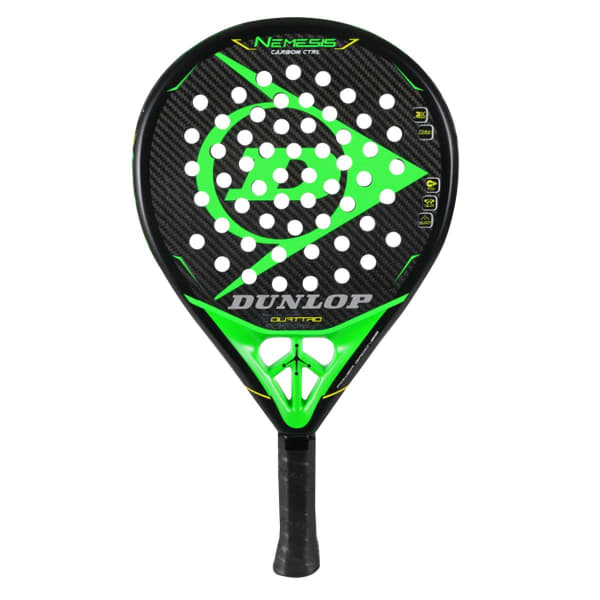
Dunlop Nemesis Carbon Control 2025
✓Cross-checked with official data from Dunlophow we score
PADELTESTLAB SCORE
0-100 scale
82/100
Price range
Description
Who this racket is for
Pros
- ✓The Soft EVA core soaks up impact so long matches don't beat up your elbow — you feel it most on repeated volley blocks Multi-dimensional face perforations spread the sweet spot across a wide area — a volley caught near the top edge still comes out with direction instead of dying short Low balance lets you make last-second corrections on tricky wall exits and still send a deep lob when the ball kicks off with weird spin The rough surface grips the ball, making it easy to slice the bandeja and add lift to the lob without having to speed up your arm Structural reinforcement on the frame edges protects the zone that takes the most punishment on soft-EVA rackets from court and wall scrapes
Cons
- ✗Ball exit is muted: the flat smash that's meant to close out a point needs real arm speed — this racket won't add the extra metres for you With no weight up top, the vibora leans entirely on wrist snap — if your side-spin technique isn't dialed in yet, the shot comes out flat The soft core loses definition when you want a sharp, quick response from the back of the court A player who hasn't yet developed their own racket speed will feel this frame come up short trying to finish from mid-court
PADELTESTLAB SCORE
0-100 scale
82/100
It is at its lowest price since we started tracking it: €69.95, down from €79.95. We began recording on March 20.
Prices recorded daily since March 20 · 86 days of data
Round-shaped, soft underfoot and riddled with holes on the face — the Dunlop Nemesis Carbon Control 2025 tells you exactly what it's about before you've hit a ball. 3K carbon on the face, a Soft EVA core and a low balance point add up to a racket built for precision and fast wrist work, not brute force.
3K Carbon over Soft EVA: where that touch comes from
3K carbon is a wide-weave fabric. It keeps carbon's structural stiffness but flexes more than tighter weaves, and that translates into a face that holds the ball a fraction longer before releasing it.
Pair that with the Soft EVA core and impact reaches your arm cushioned — none of that harsh jolt that punishes your elbow over a two-hour match.
That softness comes at a cost. This padel racket doesn't give energy back, it manages it: anyone expecting a catapult effect that pushes the ball on its own from the back of the court will find a frame that demands arm input instead.
The frame carries structural reinforcement on the edges, exactly where soft-EVA rackets wear out fastest from court and wall contact. It doesn't add pop — it adds lifespan.
What do the Perforaciones multidimensionales en cara (multi-dimensional face perforations) actually do?
The multi-dimensional perforations cut through the hitting surface at various angles rather than straight through. They shave mass off the upper face and change how the surface flexes on contact — the sweet spot spreads across a wide area instead of sitting in one tight spot dead centre.
On court, it shows up on off-centre hits. A volley taken near the top edge still comes out with direction — it doesn't sag or fall short the way it would on a stiffer, more compact face.
The throat adds flat vents for airflow. They shave weight off the lower part of the frame and push mass toward the handle, in line with the low balance.
How it plays on bandeja, vibora and wall exits
The round shape combined with the low balance shows up from the first warm-up: the head feels light and the racket whips through the forearm quickly.
- **Bandeja**: its best shot by far. Sliced, with the racket dropping over the shoulder, the Soft EVA lets you carry the ball deep and drop it long without needing to speed up.
- **Vibora**: it's there, but it demands technique. With no weight up front, the side spin comes purely from wrist snap, not head inertia.
- **Wall exit**: this is where it shines. The maneuverability gives you room to correct late on a ball that kicks off the wall with spin and turn it into a deep lob.
- **Volley**: firm, precise blocking — the wide sweet spot forgives off-centre contact in quick net exchanges.
- **Smash**: the kick smash and the smash de tres work fine, but the flat smash meant to close the point needs arm behind it.
The rough surface makes up for some of that restraint. It grips the ball well and makes slicing and lifting easier with less effort — handy on the dejada and on the lob with spin.
Does the Dunlop Nemesis Carbon Control hit hard?
No, and it's not trying to. The Soft EVA core and low balance point prioritise touch and maneuverability over raw ball exit. There's enough power to finish points, but the racket player supplies the speed: this is a racket for building the point, not ending it in one shot.
Nemesis Carbon Control spec sheet
| Spec | Value |
|---|---|
| Shape | Round |
| Balance | Low |
| Face | 3K Carbon |
| Core | Soft EVA rubber |
| Surface | Rough |
| Playing style | Control |
| Level | Advanced |
| Tech | Multi-dimensional face perforations, structural edge reinforcement, flat throat vents |
Who is this Dunlop racket actually for?
The natural fit is the advanced player with solid technique already in place, someone who can generate their own ball speed and plays the net working bandejas and deep volleys rather than hunting a winner on every approach.
It also suits the intermediate-to-advanced player looking to step up to a demanding racket without jumping into a hard core — the soft touch and wide sweet spot make that transition less jarring.
As a doubles pairing, it complements a partner running a head-heavy, power-hitting racket well. One player holds the point and places the ball; the other closes it out.
Players dealing with elbow or wrist niggles will find the 3K carbon plus Soft EVA combo one of the kinder setups going for the joints.
What you gain — and what you give up — with this racket
You gain fine control, forgiveness on off-centre hits, and a racket that won't let you down on defence. The Dunlop Nemesis Carbon Control is the kind of frame that cuts unforced errors from your very first match with it.
What you give up is speed. The soft core loses definition when you need a sharp response from the back of the court, and with no mass up top, the flat smash rests entirely on your own technique.
If your game is about grinding out rallies, moving your opponents around and waiting for the short ball, this trade-off works in your favour. If your idea of padel is finishing points from up at the net, this isn't your racket.
In the brand's lineup
Within Dunlop's lineup, the Nemesis Carbon Control is one of the most accessible options starting at €69.95, perfect for getting started without a heavy outlay. Its overall score of 82/100 places it among the best control rackets we've reviewed.
Frequently asked questions
Who is the Dunlop Nemesis Carbon Control 2025 for?
The Dunlop Nemesis Carbon Control 2025 targets advanced players. It needs consolidated technique and is not recommended for beginners.
What's the Dunlop Nemesis Carbon Control 2025's PadelTestLab score?
The Dunlop Nemesis Carbon Control 2025 scores 82/100 in our review, based on power, hardness, control, maneuverability, ball exit, sweet spot and surface roughness.
How much does the Dunlop Nemesis Carbon Control 2025 cost?
Current price of the Dunlop Nemesis Carbon Control 2025 is 69.95€, comparing 1 shop in our finder.
Similar alternatives
Other rackets with a similar profile and price range: