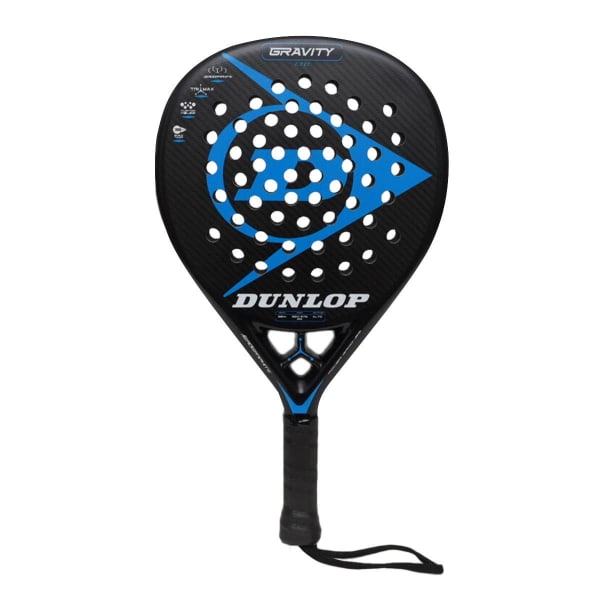
Dunlop Gravity 2025
✓Cross-checked with official data from Dunlophow we score
PADELTESTLAB SCORE
0-100 scale
78/100
Price range
Description
Who this racket is for
Pros
- ✓The PRO TOUCH medium EVA core does the work for you off the wall and on defensive lobs, popping the ball back without needing a full-length swing The Tri-Max reinforcement, anchored at three points on the bridge, kills twist on body-height blocking volleys — exactly where a 38mm teardrop usually turns in your hand The Extra Grip finish on the carbon/graphite hybrid face bites into the ball on a cut vibora and a kick bandeja, with grip you feel from the first set At 38mm and 360-375g, this racket keeps its maneuverability sharp despite the power-oriented build, snapping into fast volleys and improvised smashes with ease
Cons
- ✗The sweet spot sits high toward the tip and stays tight — hits toward the throat come out muted, forcing you to adjust your contact height With medium EVA and such generous ball exit, flat, hard hitters will overhit the smash by por 3 until they dial in the depth This isn't a beginner-friendly racket: it demands solid technique to unlock the power without losing placement on the return of serve The 360-375g range leaves little room for players chasing a lightweight feel — over long matches, the arm feels the top end of that range
PADELTESTLAB SCORE
0-100 scale
78/100
It is at its lowest price since we started tracking it: €59.95, down from €69.95. We began recording on March 20.
Prices recorded daily since March 20 · 84 days of data
Dunlop Gravity 2025 Review: The 38mm Teardrop That Launches the Ball Off the Wall
The Dunlop Gravity 2025 is the tour racket tied to Juani Mieres, and there's nothing ambiguous about its setup: teardrop shape, 38mm frame, PRO TOUCH medium EVA core, carbon-and-graphite faces with a textured finish, and a weight range of 360-375g. Everything about it points to an advanced player who wants to hit hard without giving up racket speed.
What stands out about this padel racket isn't raw power — it's where that power comes from. The Gravity delivers ball exit that's well beyond what you'd expect from an attacking racket, and that changes the way you handle defensive shots entirely.
Dunlop Gravity 2025 Specs
| Spec | Value |
|---|---|
| Shape | Teardrop |
| Weight | 360-375 g |
| Face | Hybrid (carbon and graphite) |
| Core | EVA medium — PRO TOUCH |
| Frame | 38 mm |
| Surface | Sandy texture |
| Technologies | Tri-Max, Extra Grip |
| Level | Advanced |
| Playstyle | Power |
What Does the PRO TOUCH Medium EVA Core Actually Do?
Medium-density EVA isn't a soft beginner's foam, nor is it the rock-hard block you find in pure competition rackets. It sits in a sweet spot where the ball sinks in just enough for the material to load and release energy, without your arm paying for a harsh, dead response.
On the Gravity, that middle-ground density translates into something very specific: the ball comes off the face on its own. On a low wall exit, when you're stretched and can't accelerate through the shot, the racket still clears the ball out of danger. On a defensive lob from the back, you reach the opponent's baseline without forcing anything.
That generosity comes with a trade-off. Players used to harder cores who like to flatten out their smash will overhit their first few balls until they recalibrate. It's not a flaw in the racket — it's a genuine adjustment period worth expecting.
Tri-Max and Extra Grip: What Each One Actually Does
Tri-Max is the evolution of the Tri-Bar reinforcement: a 3D structure anchored at three points along the racket's bridge. Its job is controlling torsion. On a 38mm teardrop with weight distributed toward the top, off-center hits tend to twist the head; the triple anchor point cuts down that twist and delivers a sense of control the shape alone wouldn't provide.
You feel it most on chest-height blocking volleys against a heavy smash, and on a vibora struck as the racket is already dropping.
Extra Grip is the abrasive finish on the faces. It adds bite on both ends of the court: a kick bandeja jumps higher off the bounce, and a cut vibora hugs the side glass. Paired with the sandy texture, this is grip you notice from the very first exchange.
The faces blend carbon and graphite with a multidimensional hole pattern that manages airflow, built to keep the racket stable at the moment of impact on a smash.
Who Should Actually Play With the Dunlop Gravity?
Straight answer: advanced players with technique already dialed in. The Gravity demands precise hand placement on contact because the sweet spot is compact and shifted toward the tip, prioritizing power on smashes and volleys over any forgiveness on mishits. An intermediate player will find a fast racket that's unforgiving on low-contact shots.
Who it suits best:
- **Backhand-side players** who finish points por 3 and want consistent depth on the bandeja.
- **Quick net players** who need a maneuverable racket for reaction volleys, not an inert 38mm slab.
- **Aggressive players who still defend a lot** — anyone who'll appreciate a racket that bails them out on a late wall exit.
It's not the right fit for players chasing a pure control racket to build points patiently from the back — the Gravity's character is offensive, and the sweet spot doesn't forgive sloppy contact.
Shot-by-Shot Breakdown
Smash por 3. This is where the racket sells itself. Catching the ball high on the teardrop, the combination of the 38mm frame and weight toward the 375g end sends it into the glass with real exit speed. The key is making contact up top — drop two centimeters and the shot noticeably dies.
Bandeja. Extra Grip lets you slice with confidence and keep the ball low after the bounce. The maneuverability helps you reach awkward bandejas above shoulder height.
Vibora. One of this padel racket's standout shots. The teardrop shape concentrates mass right where you strike the vibora, and the sandy texture holds the side spin.
Defense and wall exits. Comfortable territory thanks to PRO TOUCH. This is the trait that separates this Dunlop from other attacking teardrops, which usually punish defensive players.
Volleys. Nimble on reaction volleys, solid on blocking volleys thanks to Tri-Max. On a finishing volley close to the body, you need to watch your contact height.
Verdict: Power With a Safety Net on Defense
The Dunlop Gravity solves a common tension in 38mm teardrops: hitting hard without getting stranded when you're pushed back. PRO TOUCH provides that safety net, and Tri-Max holds the structure together on the off-center hits the shape itself tends to invite.
The cost is a compact, forward-shifted sweet spot that demands precision, plus a 360-375g weight range that won't suit anyone after a lightweight feel. If your game is built around smashing, sneaking in the vibora, and grinding out long defensive rallies, this racket delivers. If forgiveness on mishits is your top priority, look elsewhere.
In the brand's lineup
Within Dunlop's lineup, the Gravity is one of the most accessible options starting at €59.95, perfect for getting started without a heavy outlay. With an overall score of 78/100, it's a solid choice within its price range.
Frequently asked questions
Who is the Dunlop Gravity 2025 for?
The Dunlop Gravity 2025 targets advanced players. It needs consolidated technique and is not recommended for beginners.
How much does the Dunlop Gravity 2025 weigh?
The Dunlop Gravity 2025 weighs 360-375g according to the manufacturer's stated specs.
What's the Dunlop Gravity 2025's PadelTestLab score?
The Dunlop Gravity 2025 scores 78/100 in our review, based on power, hardness, control, maneuverability, ball exit, sweet spot and surface roughness.
How much does the Dunlop Gravity 2025 cost?
Current price of the Dunlop Gravity 2025 is 59.95€, comparing 1 shop in our finder.
Similar alternatives
Other rackets with a similar profile and price range: