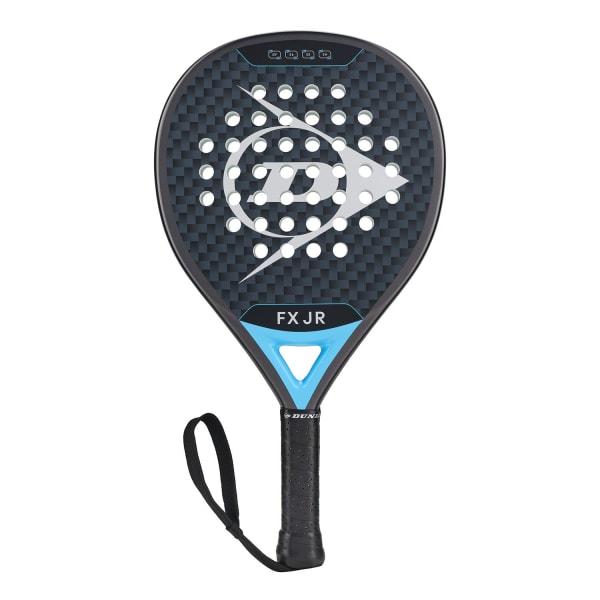
Dunlop FX Junior
✓Cross-checked with official data from Dunlophow we score
PADELTESTLAB SCORE
0-100 scale
78/100
Price range
Description
Who this racket is for
Pros
- ✓That fixed 335 g weight and slim 36 mm profile mean a kid can actually get to a reflex volley without having to loosen their grip mid-swing to muscle the racket into position The Soft EVA core sends the ball back with minimal effort on the player's end: on defensive lobs from the back of the court, a child can land it deep in the opponent's court without straining the shoulder The fiberglass face soaks up off-center hits, which matters a lot when a junior is still learning the salida de pared and catching the ball low on the face The teardrop shape puts a wide sweet spot right in the geometric center, giving young players consistency on flat forehands and backhands while they groove their technique
Cons
- ✗The smooth surface barely bites the ball, so vibora and cut shots come off flat — without the kick an advancing junior starts craving once they begin adding topspin Between the soft core and the featherweight 335 g build, flat smashes lack real depth — the ball sits up high and comfortable for the opponent to attack The even balance doesn't give you the head-heavy swing weight to lean on, so as soon as a player's arm gets stronger, this racket runs out of power Think of it as a bridge racket: realistically it's good for the season or two it takes a kid to graduate into an adult-format frame
PADELTESTLAB SCORE
0-100 scale
78/100
It is at its lowest price since we started tracking it: €44.95, down from €51.95. We began recording on March 20.
Prices recorded daily since March 20 · 38 days of data
Dunlop FX Junior Review: A 335g Padel Racket Built to Protect Young Arms
The Dunlop FX Junior is the kids' model in the FX Series 2026 lineup, and it's built around four very deliberate choices: a fixed 335 g weight, a Soft EVA core, a fiberglass face and a slim 36 mm teardrop-shaped frame. None of those numbers is an accident on a racket designed for small hands.
The real problem for a kid just starting out isn't lack of power — it's that most rackets are heavier than their forearm can stabilize. Every off-center hit twists the wrist. The FX Junior tackles that issue before anything else.
What age and skill level is the Dunlop FX Junior for?
It's aimed at junior players in the early learning stage, with no prior experience, who are still grooving the basics: forehand, backhand, volley and lob. The 335 g weight and soft core let them string together long hitting sessions without fatigue or strain on the elbow and shoulder — which is really what holds back progress at that age.
This isn't a racket for a junior who's already competing and looking to put shots away. It's the tool for year one or two.
Tech Specs
| Spec | Value |
|---|---|
| Shape | Teardrop |
| Weight | 335 g |
| Balance | Even |
| Face | Fiberglass |
| Core | Soft EVA |
| Frame | 36 mm |
| Surface | Smooth |
| Level | Beginner |
| Playstyle | All-round |
Soft EVA and fiberglass: why this pairing is so forgiving
The Soft EVA core is the centerpiece. A softer core deforms more on impact, gives back more energy on its own, and needs less arm speed to send the ball deep. On court, that means a kid can clear the ball from the baseline without a full swing or perfectly synced legs and torso.
That same deformation explains the shock absorption. As the core compresses, it soaks up a good chunk of the vibration before it ever reaches the grip — and that's where a junior racket earns half its value.
The fiberglass face works toward the same goal. It's a more elastic, noticeably less rigid material than carbon, so the hitting surface gives a little on impact instead of snapping back hard. In practice, a ball caught low on the face doesn't turn into a jolt through the wrist. The fiberglass is carbon-reinforced to hold up against wall and floor contact without adding weight.
The 36 mm frame ties it all together — a slimmer profile lowers structural stiffness and reinforces that same cushioned feel.
Teardrop shape for kids: where the sweet spot sits
The teardrop shape with even balance is a deliberate compromise. It spreads the mass out instead of loading it into the head, so a child can adjust the racket face mid-swing — something they're constantly doing while still misjudging the bounce.
Dunlop describes the shape as a hybrid headsize built to maximize the sweet spot. On court that translates to a generous, centered hitting zone sitting just above the geometric center — no need to find the tip for the ball to come off clean.
Here's how it plays shot by shot:
- **Baseline rallies**: easy depth — the ball clears the net on a half swing.
- **Salida de pared**: forgiving on late contact, the number one mistake beginners make.
- **Volley**: very maneuverable; blocks work even when you're rushed.
- **Lob**: comfortable, though fine control over length comes with technique, not the racket.
- **Smash**: it goes over, but without weight behind it — the ball sits up high for the opponent to punish.
Where this padel racket falls short
Let's be upfront about the limits, because they mark the point where it's time to move on.
The smooth surface generates no bite. Once a player starts hunting for a cutting vibora or kick on the serve, they'll notice the ball comes off clean with no grip. That's the day the FX Junior stops delivering what they need.
The second ceiling is power. A Soft EVA core at 335 g with even balance doesn't build up head-heavy inertia — a flat smash into the third box turns into a placement shot, not a finisher. It's a conscious trade-off for comfort, and for the player this racket targets, it's the right call.
Verdict: the right racket for year one, not year three
This Dunlop does the one job a beginner's junior racket needs to do: it won't hurt young arms, won't tire them out, and lets a kid hit thousands of balls until the technique becomes automatic. The Soft EVA core and fiberglass face are the coherent technical answer to that brief.
The mistake would be buying it for a junior who's already two seasons in and looking to attack. There, the lack of surface grip and the power ceiling become an immediate limitation.
Honest recommendation: buy it if your kid is just starting out, and plan on upgrading in a season or two — once their arm gets stronger and they start asking for more spin — to a heavier frame with more bite on the hitting surface.
In the brand's lineup
Within Dunlop's lineup, the FX Junior is one of the most accessible options starting at €49.95, perfect for getting started without a heavy outlay. With an overall score of 78/100, it's a solid choice within its price range.
Frequently asked questions
Who is the Dunlop FX Junior for?
The Dunlop FX Junior is built for beginner level: easy to handle and forgiving. Not the ideal pick if you already have consolidated technique.
How much does the Dunlop FX Junior weigh?
The Dunlop FX Junior weighs 335g according to the manufacturer's stated specs.
What's the Dunlop FX Junior's PadelTestLab score?
The Dunlop FX Junior scores 78/100 in our review, based on power, hardness, control, maneuverability, ball exit, sweet spot and surface roughness.
How much does the Dunlop FX Junior cost?
Current price of the Dunlop FX Junior is 49.95€, comparing 1 shop in our finder.
Similar alternatives
Other rackets with a similar profile and price range: